
What is the PPWR? The EU Packaging Rules Explained

Most compliance rules start with a filing. You gather data, you submit a form, a portal gives you a number, and the job is done for that shipment.
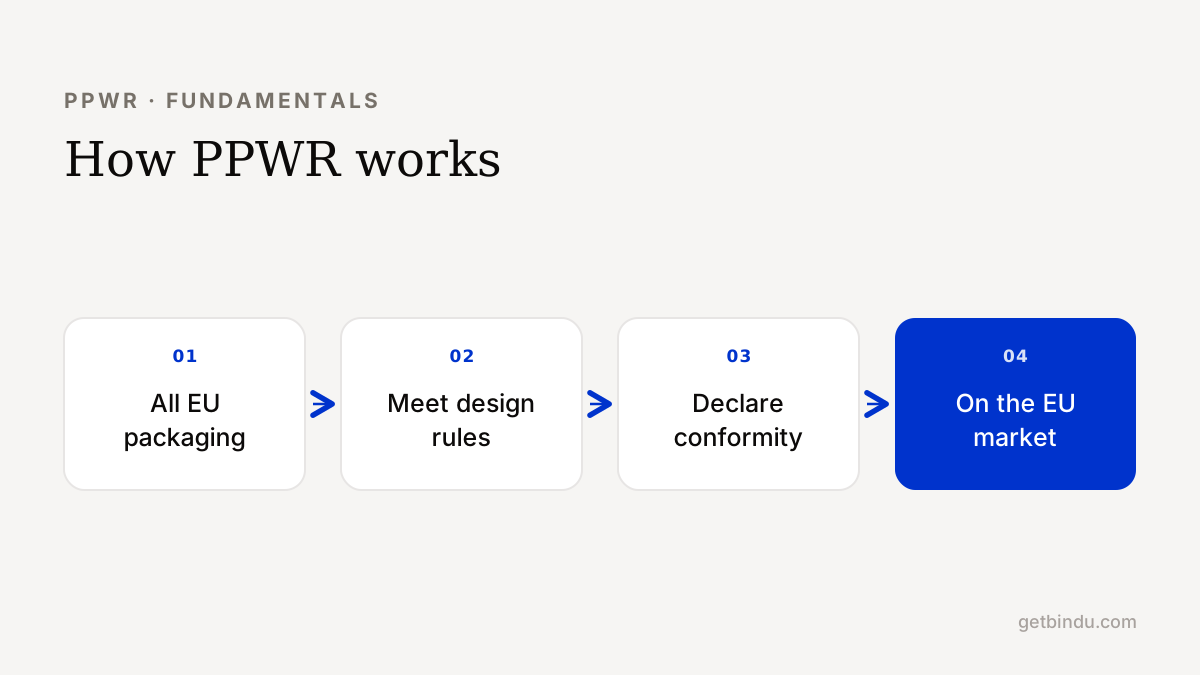
The PPWR does not work like that.
There is no portal, no annual return, no number to wait for. Instead the rule reaches back into the box itself, the film, the tray, the label, the ink, and says: this has to be built a certain way, and you have to hold the paper that proves it.
If you make, import, or sell almost anything wrapped in the EU, this rule is now yours.
At a glance:
- PPWR is the EU's Packaging and Packaging Waste Regulation, Regulation (EU) 2025/40.
- It replaces the 1994 Packaging and Packaging Waste Directive and applies directly in every member state.
- It entered into force on 11 February 2025 and starts to apply on 12 August 2026.
- It sets design rules on substances, recyclability, recycled content, minimisation, and labelling.
- There is no EU portal. You build packaging to the rules and hold a declaration of conformity ready to show.
What is the PPWR?
PPWR is the EU's Packaging and Packaging Waste Regulation, an EU law formally known as Regulation (EU) 2025/40. It is one packaging rulebook for the whole EU market.
It replaces the old Packaging and Packaging Waste Directive from 1994. That shift, from directive to regulation, is the whole story of why this one is different.
A directive is a set of goals that each country writes into its own national law, in its own way. A regulation is the law itself. It applies directly and identically in every member state. There is no national version to wait for, and no local wording to interpret.
So the PPWR binds every operator that puts packaging on the EU market, wherever that operator sits.
It entered into force on 11 February 2025. It starts to apply on 12 August 2026. Some obligations, such as harmonised labelling, then phase in on later dates.
What does it actually require?
The PPWR is not one obligation. It is a stack of design rules that ride on the packaging itself. The table below sets out the main ones and where each sits in the text.
| Design rule | What the PPWR requires |
|---|---|
| Substance limits (Article 5) | Packaging may not contain certain hazardous substances above set thresholds. PFAS are restricted in food-contact packaging under Article 5(5). |
| Recyclability (Article 6) | Each unit is graded A, B, or C. Below 70 percent, packaging is treated as non-recyclable and its sale can be restricted. |
| Recycled content (Article 7) | Plastic packaging must contain a minimum share of recycled plastic, rising over time. |
| Minimisation | Packaging must be no larger or heavier than it needs to be, with a cap on empty space in grouped and e-commerce packaging. |
| Labelling (Article 12) | A harmonised label tells the consumer what the packaging is made of and how to sort it. |
| Declaration of conformity | You draw up a written statement for each packaging type on the model in the regulation, and keep it current. |
A declaration of conformity is the written statement, on the model set out in the regulation, in which you take responsibility that a packaging type meets the rules. You can read how to build one in the PPWR declaration of conformity guide.
Where the rules bite
Two of these rules bite hardest. Recyclability under Article 6 is graded A, B, or C, and a unit below 70 percent counts as non-recyclable, which can gate whether it may be sold at all. Article 5(5) singles out PFAS in food-contact packaging, so a pack that touches food can fail on its coating alone.
The quieter rules still reshape a product. Minimisation forces packaging down to what the product needs and caps empty space, so oversized cartons have to shrink. Recycled content sets a rising floor for recycled plastic, so a design that passes today can fall short at the next step. The dates each of these lands on are in the PPWR timeline.
So the PPWR works the other way round from a filing. There is no form to send. You keep the file yourself, ready to show, for every kind of packaging you place on the market. If an authority asks, you produce the documentation and the declaration on request. Nothing is lodged in advance.
What counts as packaging
Packaging under the PPWR is not just the box a customer sees. The regulation works across formats, and the format decides which rules reach a given item. If you know the old primary, secondary and tertiary labels, sales packaging is primary, grouped is secondary and transport is tertiary.
- Sales packaging is the unit the consumer takes home, the box, bottle, tray or wrapper around the product itself.
- Grouped packaging holds several sales units together, such as the shrink film around a multipack.
- Transport packaging protects goods in transit, such as the outer carton, pallet wrap and strapping.
- E-commerce packaging is the shipping box used to fulfil an online order.
- Service packaging is designed and intended to be filled at the point of sale, like a takeaway cup or a bakery bag.
Format also sets the empty-space rule. Whoever fills grouped, transport or e-commerce packaging has to keep the empty space ratio at or under 50 percent from 1 January 2030.
One distinction catches people out. Transport packaging is exempt from the Article 12 harmonised label, but e-commerce packaging is not. A brand that ships direct to consumers labels the box it posts, while the same brand shipping pallets to a retailer does not label the pallet wrap.
One product, five answers
Take a boxed kitchen appliance sold both in shops and online. The rules land on each component separately, and that is how a PPWR file is actually built.
| Component | Format | The rules that reach it |
|---|---|---|
| Printed retail box | Sales packaging | Recyclability grade (Article 6), minimisation and empty space, harmonised label (Article 12), substance limits on the inks (Article 5) |
| Moulded insert | Sales packaging | Recyclability grade, recycled content if plastic (Article 7), minimisation |
| Shrink film over multipacks | Grouped packaging | Recyclability grade, recycled content, the empty-space cap |
| Outer shipping carton to a retailer | Transport packaging | Recyclability grade and minimisation, but no Article 12 label |
| Mailing box for an online order | E-commerce packaging | Recyclability grade, minimisation with the empty-space cap, and the Article 12 label |
Each of those needs its own declaration of conformity, because each is a distinct packaging type. That is the practical scale of the PPWR, and why the file grows faster than people expect.
Who is responsible?
The PPWR stacks duties by role. A single company can be the manufacturer, the importer and the distributor for the same box.
| Role | Article | Duty |
|---|---|---|
| Manufacturer | Article 15 | Designs the packaging to meet the rules and holds the technical documentation. |
| Producer | Article 44 | First makes the packaging available in a given country, and carries the extended-producer-responsibility and registration duties there. |
| Importer or distributor that rebrands or modifies | Article 21 | Becomes the manufacturer and inherits the full manufacturer duty set. |
Article 21 is where the roles change hands. The moment an importer or distributor puts its own name or trademark on the packaging, or modifies it, that company becomes the manufacturer. It inherits the full manufacturer duty set.
So a retailer selling own-brand goods, or an importer relabelling a product, is very often a PPWR manufacturer without having designed a single tray.
A worked example. A distributor imports boxed kitchen goods and sells them under its own store brand. It did not design the tray or the outer carton. But the moment it prints its own trademark on the packaging, Article 21 makes it the manufacturer. Now it must hold the technical documentation under Article 15, grade each pack for recyclability under Article 6, and draw up a declaration of conformity for every packaging type. One label change moved the whole duty set onto the distributor.
How it fits with the rest of trade compliance
Packaging has its own rules, separate from what is inside it. So one pallet can owe two answers. A carton of coffee sachets raises two questions. The EUDR asks about the beans. The PPWR asks about the carton, the sachet and the printing ink. Import steel cookware and CBAM asks about the carbon in the pan. The PPWR asks if the box it came in can be recycled.
Inside a company those two answers usually sit with different people. Customs sees one consignment. So the packaging evidence has to sit next to the product evidence. That is what trade compliance means in practice.
Where Bindu fits. Bindu maps each product to its packaging types and reads the PPWR requirements straight from Regulation (EU) 2025/40, so what applies to a given pack comes from the text itself. When the Digital Product Passport turns packaging data into a published record, that same data lands there. See the PPWR breakdown.
FAQ
What does PPWR stand for? PPWR stands for the Packaging and Packaging Waste Regulation, formally Regulation (EU) 2025/40. It is the EU law that sets design, substance, recyclability, recycled-content, and labelling rules for packaging placed on the EU market.
Source: EUR-Lex: PPWR, Regulation (EU) 2025/40
What is the difference between the PPWR and the old packaging directive? The 1994 rule was a directive, so each EU country wrote it into its own national law. The PPWR is a regulation, so it applies directly and identically across the whole EU with no national transposition. That makes the requirements the same in every member state.
Source: EUR-Lex: PPWR, Regulation (EU) 2025/40
Source: European Commission: Packaging and packaging waste
When does the PPWR apply? The PPWR entered into force on 11 February 2025 and starts to apply on 12 August 2026. Other obligations, such as harmonised labelling, follow on later dates.
Source: EUR-Lex: PPWR, Regulation (EU) 2025/40
Does the PPWR involve a filing or a portal? No. There is no central EU portal and nothing to submit for each product. The PPWR requires you to build packaging to its rules and hold documentation, including a declaration of conformity, ready to show on request. Producer registration happens nationally, per country.
Source: EUR-Lex: PPWR, Regulation (EU) 2025/40
Who has to comply with the PPWR? Manufacturers, importers, distributors, and producers of packaging placed on the EU market. Importers and distributors that put their own brand on packaging, or modify it, are treated as manufacturers and take on the full manufacturer duties.