
PPWR Declaration of Conformity: What It Requires


Search for a "PPWR declaration of conformity template" and you will find plenty of downloads. Most of them miss the point.
The declaration is the signed conclusion of work you do first, and it is only as true as the assessment behind it. A blank template hands you the last page and skips the book.
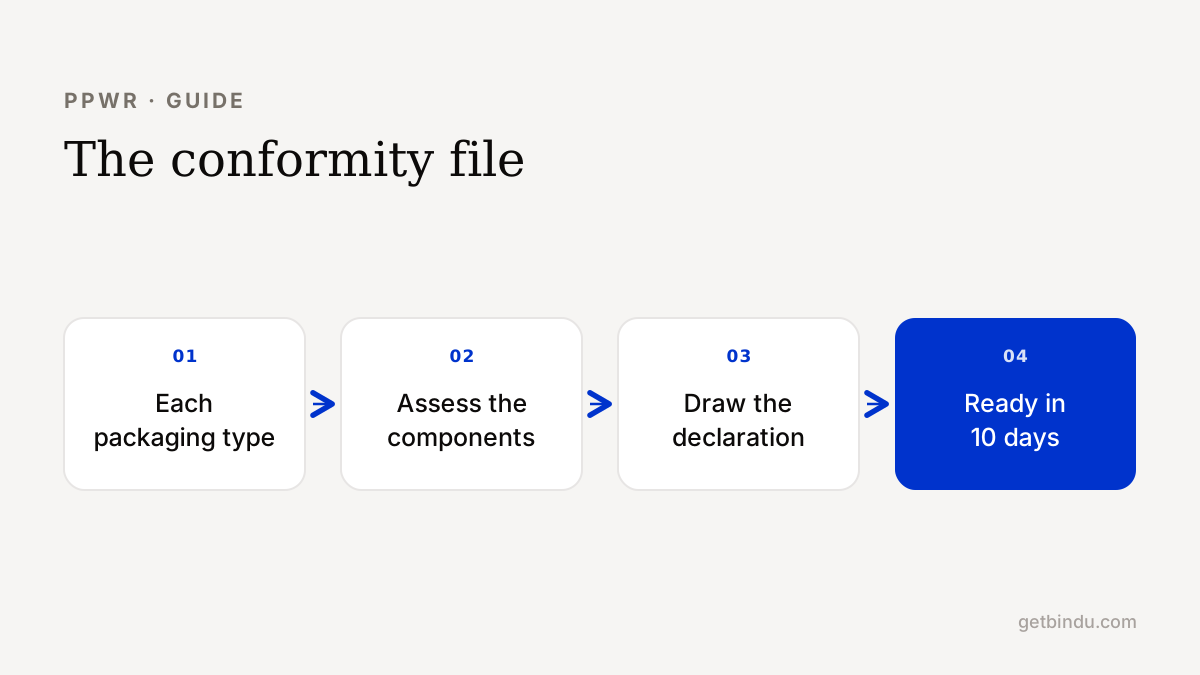
Four things make it more than a form. Each one is a reason a template alone will not save you.
At a glance:
- It is written per packaging type, so one declaration can cover forty products.
- It is assessed on each component: the adhesive, the ink, the coating.
- It must be kept continuously up to date as products change.
- It has no portal: you hold it and produce it on request, in practice within about 10 days.
What is a PPWR declaration of conformity?
A PPWR declaration of conformity is a written statement required under the PPWR (Regulation (EU) 2025/40). In it, the manufacturer declares that a packaging type meets the regulation's requirements. It is the manufacturer's formal statement of conformity. By signing it, the manufacturer takes legal responsibility for the packaging.
The documentation requirement sits in Annex VII. The declaration itself follows the model in Annex VIII of the regulation. It is part of the technical documentation. It becomes required when the PPWR applies on 12 August 2026 (see the PPWR timeline). For the wider set of duties around it, see what the PPWR is.
What the Annex VIII model must contain
Annex VIII follows the EU's standard declaration-of-conformity structure. It is the same skeleton used across product regulations, set out in Decision No 768/2008/EC, the common framework for marketing products. The PPWR draws its conformity assessment from the same place: Module A, internal production control, which means you assess your own packaging rather than send it to a notified body. A generic template can reproduce that skeleton. What it cannot reproduce is the assessment each line depends on.
| Field in the model | What goes in it |
|---|---|
| Packaging identification | A unique reference for the packaging type the declaration covers |
| Manufacturer | Registered name, trade name, and address (plus the authorised representative, if any) |
| Responsibility statement | That the declaration is issued under the sole responsibility of the manufacturer |
| Object of the declaration | A description that identifies the packaging type and makes it traceable, an image where useful |
| Statement of conformity | That the packaging conforms to Regulation (EU) 2025/40 and the applicable requirements |
| Standards or specifications | References to any harmonised standards or common specifications applied in the assessment |
| Additional information | Supporting detail where relevant, for example recycled-content share or recyclability grade |
| Signature block | Place and date of issue, name, function, and signature |
Verify the exact fields against the Annex VIII text before you draw one up. The model is prescriptive and the wording matters. The point of the table is the shape of the obligation. Most fields are administrative. But two of them are only true if the work underneath is done. Those two are the object of the declaration and the statement of conformity.
One declaration per packaging type, not per product
A packaging type is a distinct combination of material, closure, and decoration. Two products share a declaration only when their packaging matches on all three.
The declaration is written per packaging type. It must identify the packaging it covers. One declaration then covers every product that uses that packaging type. So if the same 500ml PET bottle carries forty different drinks, that is one declaration, not forty.
But a different bottle, closure, or label is a different packaging type. It needs its own declaration. A single beverage range resolves like this:
| Products | Packaging type | Why it is distinct | Declarations |
|---|---|---|---|
| 40 drinks in the same 500ml PET bottle, PET cap, PP label | 500ml PET bottle unit | one type across all 40 | 1 |
| The same drinks in a 330ml aluminium can | 330ml aluminium can | different material | 1 |
| A 1L glass variant with a metal closure | 1L glass bottle and closure | different material and closure | 1 |
| The shrink film around the multipacks | LDPE grouped packaging film | different function and material | 1 |
Forty products, four packaging types, four declarations. That mapping is the first real task: from your product range down to the distinct packaging types underneath. Get it wrong, and you either write far too many declarations, or leave a packaging type uncovered.
The practical way to build the map is short:
- List every packaging component you place on the market.
- Group the components that are physically identical.
- Treat each group as one packaging type.
Two products share a declaration only when their packaging is the same. That means the same material, the same closure, and the same decoration.
It is assessed on the components
A declaration says the packaging conforms. Conformity is judged on the parts that make it up.
Recyclability and recycled content are both assessed on the components. That means the adhesives, colours, barriers, coatings, inks, and lacquers that make up the packaging. A tray that looks recyclable can fail because of one of them. A PET tray, for example, can carry a thin oxygen-barrier coating, or a dark carbon-black ink. That ink defeats near-infrared sorting at the recycling plant. The tray reads as recyclable on the shelf. In the assessment, it is then graded as not recyclable.
That component-level view is the same one the digital product passport will ask for, so the work is not wasted. Behind a single declaration sits a component-level assessment. The declaration is the summary. The technical documentation is where the working sits, component by component, for every packaging type you cover.
It is never final
Signing the declaration does not close the file.
The regulation requires the declaration to be kept continuously up to date. Any change to the design, material, or supplier can reopen the assessment. The change might alter whether the packaging still conforms. Switch the ink, move to a new film supplier, or lightweight the bottle. The assessment behind the declaration then has to be checked again.
That is a different discipline from a one-time filing. A PPWR declaration is a living document. It is tied to a physical product that keeps changing.
What you have to be ready to do
There is no EU portal for the declaration. You do not submit it anywhere. But an enforcement authority can make a reasoned request. You then have a short window, in practice around 10 days, to produce the declaration and the documentation behind it.
So the test is whether the current declaration and its assessment exist on any given day, and whether you can hand them over quickly.
That is where a template alone falls short. You must hold the right declaration for every packaging type, kept current as products change. That is a records problem.
Where Bindu fits. Bindu reads the PPWR from Regulation (EU) 2025/40 and Annexes VII and VIII directly, maps your products to packaging types, and keeps the component assessment and declaration attached to each, so the file exists before the request does. See the PPWR breakdown.
FAQ
What is a PPWR declaration of conformity? It is a written statement required under Regulation (EU) 2025/40. In it, the manufacturer declares that a packaging type meets the PPWR's requirements. It follows the model in Annex VIII and forms part of the technical documentation. The structure comes from the EU's common framework for marketing products.
Source: EUR-Lex: PPWR, Regulation (EU) 2025/40
Source: EUR-Lex: Decision No 768/2008/EC, common framework for the marketing of products
Is there a PPWR declaration of conformity template? The regulation itself provides the model, in Annex VIII, and the Commission keeps the packaging rules overview alongside it. A generic downloadable template only gives you the format. The substance is the assessment behind it. That is done per packaging type and at component level.
Source: EUR-Lex: PPWR, Regulation (EU) 2025/40
Do I need one declaration per product? No. You need one declaration per packaging type, and it must identify the packaging it covers. A single declaration covers every product that uses that packaging type. Different bottles, closures, or labels are different types. Each needs its own.
Source: EUR-Lex: PPWR, Regulation (EU) 2025/40
Do I have to submit the PPWR declaration of conformity anywhere? No. There is no central EU portal for it. You hold it as part of your documentation. You produce it, usually within around 10 days, when an enforcement authority makes a reasoned request.
Source: EUR-Lex: PPWR, Regulation (EU) 2025/40
When does the PPWR declaration of conformity become required? From 12 August 2026, the date the PPWR applies. It must also be kept continuously up to date after that. Design, material, or supplier changes can reopen the underlying assessment.