
What is Trade Compliance? A Guide for Exporters

A company has shipped the same product to the same buyer for fifteen years. Nothing about the product changed.
Then a customs officer holds the container. He asks for a statement the company has never heard of.
The goods sit at the port. Someone in the office searches the name of a rule that came into force while they were busy running the business.
That gap, between what you ship and what you can now prove about it, is what trade compliance is about.
Two years of new EU rules turned that gap from a rare surprise into a standing part of the job.
At a glance:
- Trade compliance means proving a shipment obeys every rule that applies to it, then keeping the evidence.
- It rests on five checks: classification, origin, screening, regulatory filings, and records.
- Customs is only one part. Sanctions, export controls, and the new EU filings are the rest.
- Three EU rules drive most of the new work: EUDR, CBAM, and Digital Product Passports.
- The company placing goods on the market stays responsible, even when a broker files the entry.
What is trade compliance?
Trade compliance is the work of making sure every shipment follows the laws that apply to it, and being able to prove it on demand.
It is not one rule. It is the whole set of rules that attach to a good because of what it is, where it was made, where it is going, and who is moving it.
For a company selling into or out of the EU, that means classifying the product, declaring its origin, screening against sanctions, and filing a separate statement for certain regulations before the goods move.
A wrong answer surfaces later as a held shipment, back-dated duty, a fine, or a product you can no longer sell.
The moving parts
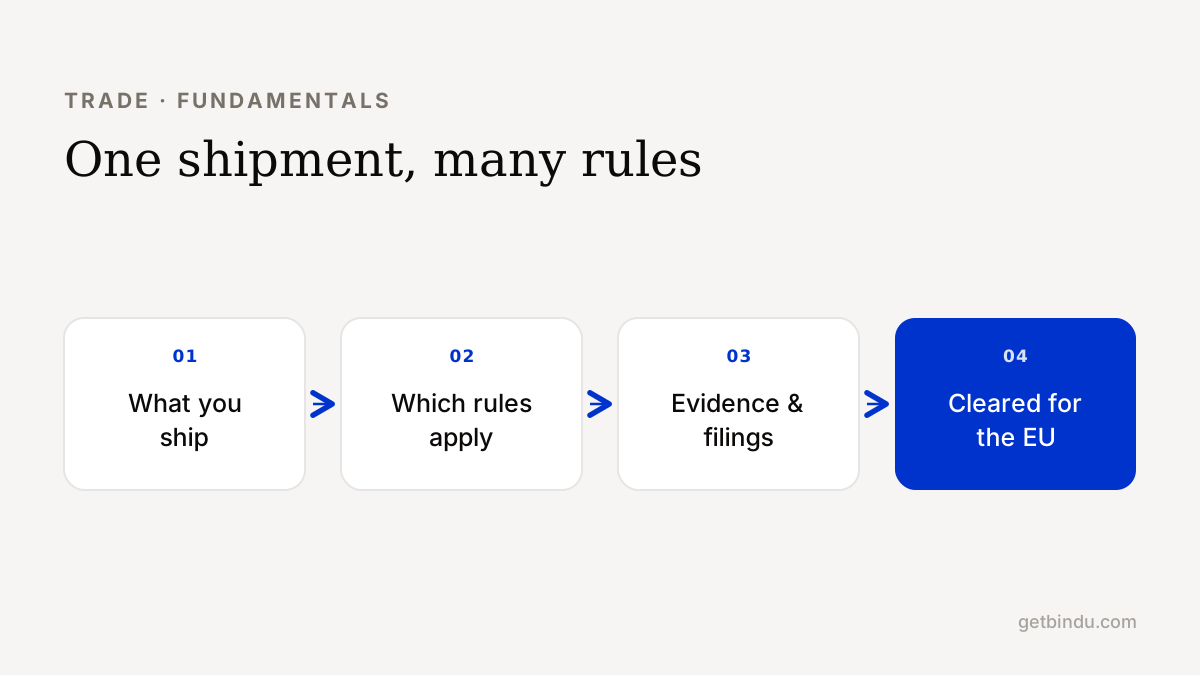
Most of trade compliance comes down to five questions about one shipment.
- Classification. What is this, in the language customs uses? An HS code is the number that classifies a product, sets its duty, and decides which rules attach to it. Every product gets an HS code, and the wrong one is the most common and most expensive mistake in the field.
- Origin. Where was it made, and does a trade deal apply? Origin decides the tariff, and sometimes whether the good is in scope at all.
- Screening. Are the buyer, the seller, and the goods clear of sanctions and export controls? This is the check that stops a legal product going to an illegal place.
- Regulatory filings. Does a specific rule need its own statement first? The EU Deforestation Regulation wants a due diligence statement. CBAM wants an emissions report. A product passport wants a data record.
- Records. Can you show all of this years later, if an auditor asks? Compliance you cannot evidence is compliance you do not have.
Answer those five for every shipment, keep the proof, and you are compliant.
None of the five questions is hard on its own. Answering all five for every product, every origin and every shipment, while the rules keep changing, is.
Origin can pull a good out of scope as easily as into it. A trade deal may drop the tariff to zero, and a commodity outside the seven EUDR categories is not in the deforestation rule at all.
A worked example
Consider a mid-sized firm that ships a commodity such as cocoa butter from Ivory Coast to a buyer in Germany. Run the five checks against that one shipment.
- Classification: the cocoa butter gets its HS code. The code sets the duty and flags that a deforestation rule may apply.
- Origin: Ivory Coast is where the beans grew. That confirms the good is a covered commodity and fixes the tariff.
- Screening: check the buyer, the seller, and the goods against sanctions and export-control lists.
- Regulatory filing: cocoa is in EUDR scope. A due diligence statement is the file EUDR requires before regulated goods move, carrying plot-level coordinates, and it must be filed before the container leaves.
- Records: keep the code, the origin proof, the screening result, and the statement, in case an auditor asks years later.
Miss the fourth step and the goods are held, even when the customs entry is perfect. That is the gap the opening described.
Why it got harder
For decades, trade compliance was mostly customs. The right code, the right value, the right paperwork. That still matters.
What changed is that the EU started attaching new obligations to whole categories of goods. Each one has its own filing, its own deadline, and its own penalty.
Three of them drive most of the new work:
- EUDR makes anyone placing coffee, cocoa, timber, rubber, soya, cattle, or palm on the EU market file a due diligence statement with plot-level coordinates.
- CBAM makes importers of steel, aluminium, cement, fertiliser, hydrogen, and electricity report the carbon embedded in those goods, and from 2027, pay for it.
- Digital Product Passports, starting with batteries and textiles, make makers publish a data record for each item.
The three rules differ in what they touch and what they demand:
| EU rule | Goods it covers | What you must file | Note |
|---|---|---|---|
| EUDR | Coffee, cocoa, timber, rubber, soya, cattle, palm | A due diligence statement with plot-level coordinates | The coordinates come from your suppliers, not your broker |
| CBAM | Steel, aluminium, cement, fertiliser, hydrogen, electricity | A report of the carbon embedded in the goods | From 2027, importers pay for those emissions |
| Digital Product Passport | Batteries and textiles, to start | A published data record for each item | More product groups follow batteries and textiles |
None of these existed five years ago. All of them land on companies that already had a full-time job.
That is why "we have always shipped this" is no longer an answer at the border.
Who owns trade compliance?
In a large company, a trade compliance team owns it. It sits between logistics, legal, and finance.
In a small or mid-sized exporter, it lands on one person who also does three other jobs. Or on a customs broker who handles the declaration but not the new filings behind it.
That split is the trap.
A broker files your customs entry. But the broker does not gather your suppliers' geolocation for EUDR, or your foundry's emissions data for CBAM.
Those obligations stay with the company placing the goods on the market. And they need data you have to collect yourself.
Filing takes an afternoon. Getting the evidence out of a supply chain is the wall most teams hit.
Where Bindu fits. Drop in an invoice, a packing list or a spec sheet, and Bindu reads it into products, parties, origins and quantities, classifies each line, and shows which rules apply. For each one it opens the right template pre-filled, so you confirm rather than build from scratch, and every plot, supplier and document is saved once for the next shipment. See how it works.
FAQ
What does trade compliance mean? Trade compliance means making sure every shipment follows the laws that apply to it, and keeping proof that you did. It covers classification, origin, sanctions screening, regulatory filings, and record-keeping.
What is the difference between trade compliance and customs? Customs is one part of trade compliance: declaring the goods, their code, and their value at the border. Trade compliance is broader. It also covers sanctions, export controls, and newer filings like EUDR, CBAM, and Digital Product Passports.
Source: World Customs Organization: What is the Harmonized System
Why is trade compliance more important now? Because the EU has attached new, product-specific obligations to whole categories of goods, each with its own filing and deadline. EUDR, CBAM, and Digital Product Passports all landed in the last two years.
Source: EUR-Lex: CBAM, Regulation (EU) 2023/956
Who is responsible for trade compliance in a company? The company placing the goods on the market is legally responsible, even when it uses a broker. Brokers file customs entries but do not gather the supplier data behind EUDR or CBAM. In smaller firms it usually falls to one person.
Source: EUR-Lex: EUDR, Regulation (EU) 2023/1115
Do I need trade compliance software? Trade compliance software is worth buying once the data work outgrows a spreadsheet. Ship a handful of products a year and a broker plus a spreadsheet may be enough. Once you have many products, many origins, and more than one EU regulation in scope, the volume decides it. The software reads your shipment documents, classifies each line, and shows which rules apply.