
What is EPR? Extended Producer Responsibility Explained

A marketplace freezes your listings. The notice asks for an EPR registration number for the country you sell into. You have fourteen days to supply one. No one on your team has heard of EPR.
That is how most brands meet extended producer responsibility. Not through a law journal, through a suspended account or a customer questionnaire.
At a glance:
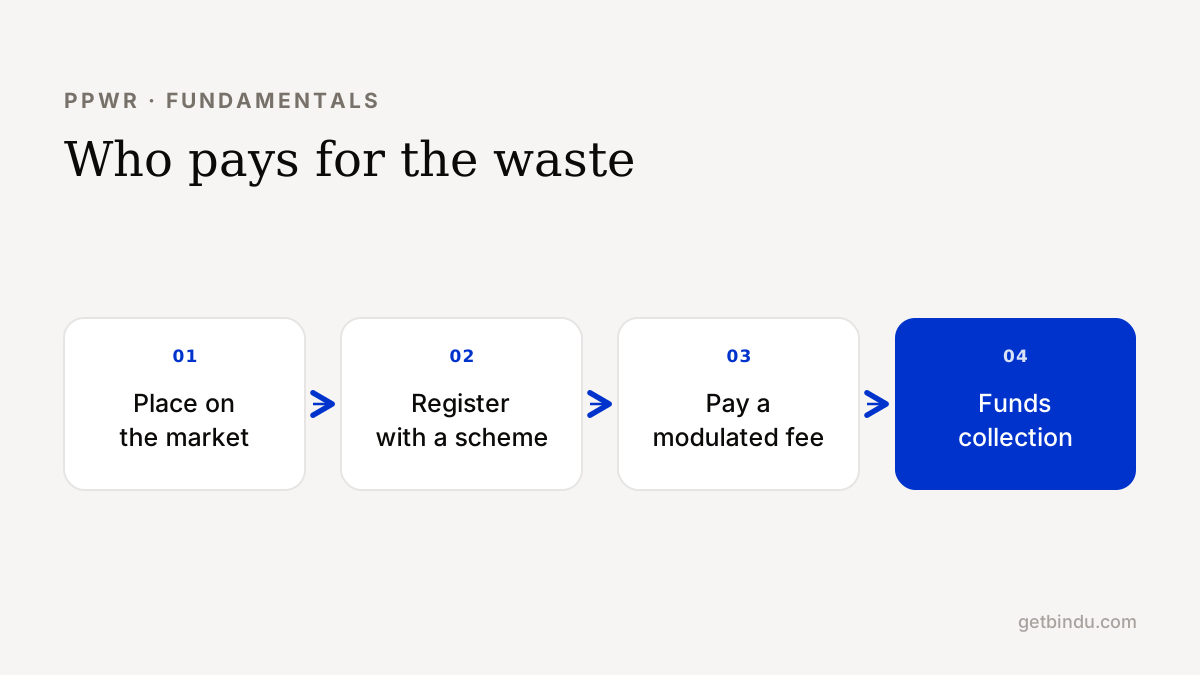
- Extended producer responsibility (EPR) is the rule that whoever puts a product on a market pays for its waste. You fund the collection and the recycling.
- In the EU the general frame sits in the Waste Framework Directive, Directive 2008/98/EC.
- Textiles were added by Directive (EU) 2025/1892, published on 26 September 2025. Every member state must have a textile scheme in place by 17 April 2028.
- You usually do not pay a government. You join a producer responsibility organisation and pay it a fee by weight or by item.
- Fees are meant to rise and fall with how recyclable a product is. The trade says the gap is still too small to change design.
What extended producer responsibility actually means
Extended producer responsibility is a policy that moves waste costs off the taxpayer and onto the company that sold the product. A town used to collect your packaging, your old kettle and your worn-out jeans, and local taxes paid for it.
EPR reverses the invoice. The producer funds the collection, the sorting, the recycling and the public notices.
This is usually not a tax. The fee is ring-fenced inside a scheme, and that scheme must prove, tonne by tonne, that it hit the targets national law sets. The plumbing differs by country, though. Hungary, for example, collects its textile contribution as a state-set charge through the national waste concession rather than as a fee to a private organisation. Read "never a tax" as a rule of thumb, not a guarantee.
The duty attaches to a market, not to a company. Selling into six countries can mean six registrations. And what you pay depends on what you sell, not on what you earn.
Who counts as the producer
The obligated producer is the first party to place the product on that national market. That is the test under most national EPR laws, and it catches more firms than the word "producer" suggests. It reaches the local maker, the importer, the brand owner selling under its own label, and the distance seller shipping in from abroad. A Dutch webshop selling into Germany is usually a producer in Germany too.
A foreign seller with no local branch usually has to name an authorised representative in each country. The mechanics, and what marketplaces check before they let you list, sit in the EPR registration post.
How the money moves
The flow is the same almost everywhere. Only the fee basis and the report fields differ.
| Stage | Who acts | What moves |
|---|---|---|
| Placing on the market | Producer or importer | The product reaches its first user in that country |
| Reporting | Producer to the scheme | Volumes by material and product category |
| Fee | Producer to the PRO | A charge by weight or by item, adjusted by product criteria |
| Collection | Towns, shops and collectors, paid by the PRO | Used products leave homes and shops |
| Sorting and treatment | Sorters and recyclers, paid by the PRO | Material is reused, recycled or disposed of |
| Proof | PRO to the national authority | Tonnes collected and recycled, against legal targets |
What a PRO is and why you deal with one
A producer responsibility organisation (PRO) is the shared body that carries out your EPR duties in return for your fee. It signs up members, collects their reports, hires collectors and sorters, and answers to the national authority for the results.
Most producers never build their own take-back system. They join a PRO because it is cheaper.
How many PROs a country licenses changes the job. France has covered clothing, footwear and household linen since 2007, and collection under the scheme started in 2009 (OECD, 2024). One organisation has run it throughout, as Eco TLC and now Refashion. One door, one fee schedule.
German packaging works the other way. A producer picks one of several competing dual systems and negotiates its own rate. The national packaging register lists them.
Which sectors already work this way
EPR has been rolled out product family by product family for over twenty years.
| Product family | Main EU legal basis | What the producer must fund |
|---|---|---|
| Packaging | Regulation (EU) 2025/40 and national schemes | Household and shop packaging, collected and recycled |
| Electrical and electronic goods | Directive 2012/19/EU | Collection, treatment, recovery and sound disposal, plus user information |
| Batteries | Regulation (EU) 2023/1542 | Collection targets, recycling rates, recovered material |
| Single-use plastics | Directive (EU) 2019/904, Article 8 | Awareness measures, collection of the Part E products, and litter clean-up |
| End-of-life vehicles | Regulation (EU) 2026/1738, replacing Directive 2000/53/EC | Free hand-in of the vehicle, then its collection and treatment |
| Textiles and footwear | Directive 2008/98/EC as amended by (EU) 2025/1892 | Separate collection, sorting for reuse, recycling |
Two rows carry a date trap. Single-use plastic EPR is already live: Article 8(1) of Directive (EU) 2019/904 requires schemes for every product in Part E of its Annex, which covers cups, food containers, wet wipes, balloons and tobacco filters.
Vehicles are mid-move. Regulation (EU) 2026/1738 was published on 24 July 2026 and entered into force on 13 August 2026. It applies from 1 September 2028, and its Article 57 repeals Directive 2000/53/EC from that same date. The producer responsibility duty starts later again, on 1 September 2029.
That row is also where "fee" is the wrong word. Article 5(4) of the old directive makes the hand-in free for the last owner, with producers meeting all or a significant part of that cost. That is a cost-coverage obligation, not a payment to a PRO.
If you already file packaging reports, the textile scheme will feel familiar. Same sign-up, same volume report, different fee grid.
The textile addition, and what its dates really say
Directive (EU) 2025/1892 is dated 10 September 2025, was published in OJ L 2025/1892 on 26 September 2025, and is in force.
Two dates matter, and they do different jobs. Article 2(1) sets the transposition deadline. Member States "shall bring into force the laws, regulations and administrative provisions necessary to comply with this Directive by 17 June 2027 at the latest".
The scheme deadline sits elsewhere. Article 1 inserts a new Article 22a into the Waste Framework Directive, and paragraph 14 is the one to read. Member States "shall ensure that the extended producer responsibility schemes laid down in paragraph 1 of this Article are established by 17 April 2028". A textile scheme is mandatory. No country gets to skip one.
That 2028 date appears in one other place, and it is easy to misread. Article 22a(11)(b) is a cost-coverage rule. It fixes which products a producer has to pay for, keyed to when they were first made available. The date it uses is "at the latest, from 17 April 2028". It then adds a condition: those products count "if an extended producer responsibility scheme for textile, textile-related and footwear products listed in Annex IVc is established in the Member State in question" from 16 October 2025. The "if" there scopes the cost, not the duty.
Read both dates as ceilings. A directive works through each country's own transposing law, so the register you sign, the fee you pay and the fields you report all differ by country. Scope and the country fee picture belong in the textile EPR post.
Eco-modulation, the lever that has not moved yet
Eco-modulation is the practice of moving a fee up or down with how durable, repairable or recyclable a product is. On paper it turns a waste charge into a design nudge. A mono-material garment should cost less to put on the market than a bonded blend no sorter can process.
In practice it is contested. The clearest recent picture comes from two TRUSTex research deliverables, D4.1 (June 2025) and D4.5 (June 2026). Both state that they have "not yet been validated by the granting authorities". The views below are stakeholder positions from that research, not legal authority.
Producers, recyclers and one national authority told the researchers much the same thing. The discounts on offer are too small to pay for a redesign, and the fee levels are too low to cover what sorting and recycling really cost. One consultant tied the mechanism to product data, which is one reason the Digital Product Passport and EPR keep surfacing together. Some schemes do not attempt modulation at all.
For the country-by-country fee picture, including the French tariff chain and the flat-rate schemes, see the textile EPR post.
What to do about it
Start with markets, not with law. List every country where a product of yours reaches a first user, then the product families above that you sell, such as packaging, electronics or textiles. Where the two meet is your sign-up list.
Volumes come next: weight by material and units by type, per country, per year. Most EPR pain is not legal. It is that no one owns that number. The same data serves your packaging duties under the PPWR and the wider obligations in trade compliance.
Where Bindu fits. Bindu holds the product and packaging data each scheme asks for in one record, per market. A registration or an annual return then becomes an export, not a rebuild. A country may publish its transposing law or a new fee grid. The rule then lands next to the products it touches. See the packaging breakdown.
FAQ
What does EPR stand for? EPR stands for extended producer responsibility. The company placing a product on a national market is responsible for it once it becomes waste. That duty is financial, and sometimes physical. The EU frame sits in the Waste Framework Directive.
Source: EUR-Lex: Waste Framework Directive 2008/98/EC
Who pays EPR fees? The obligated producer pays. Under most national laws that is the first party placing the product on that country's market. The label covers local makers, importers, brand owners and distance sellers. The fee usually goes to a producer responsibility organisation rather than to a government.
Source: EUR-Lex: Waste Framework Directive 2008/98/EC
Is EPR an EU law you register with directly? No. The EU sets the frame in a directive. Each member state writes its own law. It has its own register, fee basis and report fields. Your duty arises under national law, so you register per country.
Source: EUR-Lex: Directive (EU) 2025/1892
When does textile EPR start to apply? Member States must transpose the textile amendment by 17 June 2027 at the latest. They must also have an EPR scheme established by 17 April 2028. That scheme deadline is Article 22a(14) of the Waste Framework Directive, and it is not optional. A separate rule, Article 22a(11)(b), uses the same 2028 date to fix which products a producer has to pay for. National dates can be earlier.
Source: EUR-Lex: Directive (EU) 2025/1892
Does eco-modulation actually lower my fees? Only where a scheme operates it. The reported effect so far is modest. Stakeholders interviewed for the TRUSTex deliverables call current discounts too small to justify redesign spending. Those deliverables are unvalidated drafts. Some schemes apply a flat fee by weight with no modulation at all.