
What Is the EU Digital Product Passport? A Plain Guide


A digital product passport is not a form you file. It is a record tied to the product, opened by scanning a code on it.
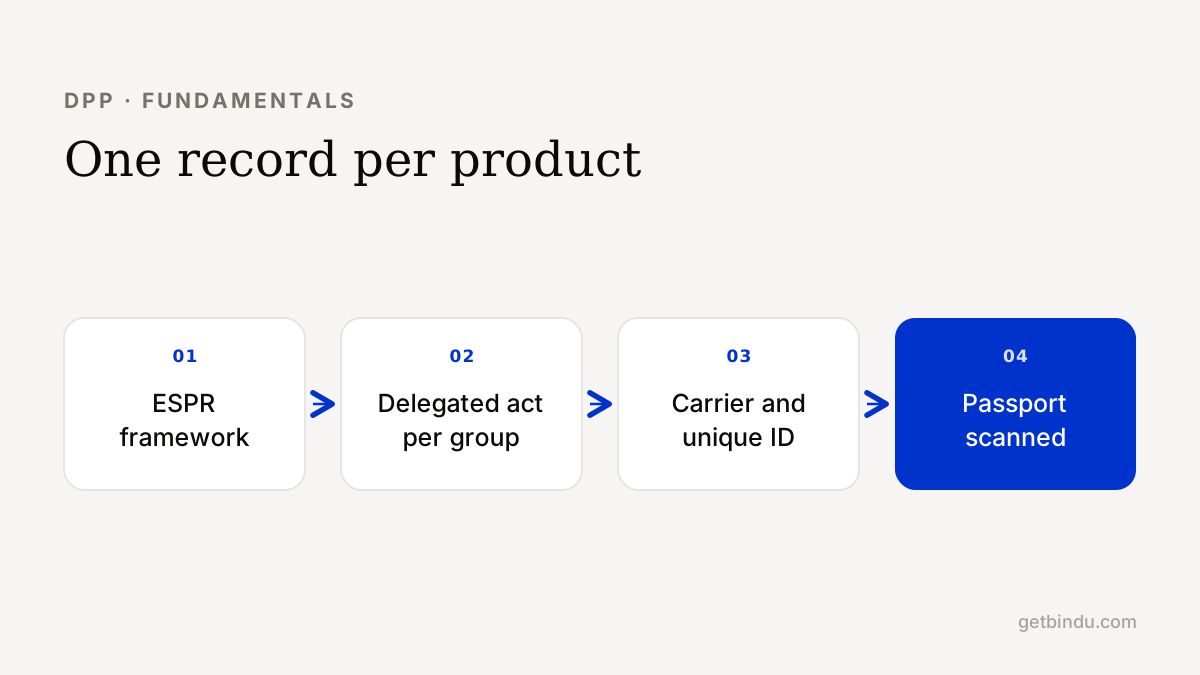
The EU has turned that idea into law. The law is the ESPR, and it will reach most physical goods sold in Europe.
At a glance:
- The EU digital product passport is a set of data about a product, read by scanning a carrier on it, defined in Regulation (EU) 2024/1781.
- That law is the ESPR. It has been in force since 18 July 2024.
- The ESPR sets the frame. The fields, the carrier and the access rules come per product group, in a delegated act.
- Textiles, furniture, tyres, mattresses, iron and steel, and aluminium lead the first working plan.
- The Commission's registry of unique identifiers went live on 20 July 2026.
- The battery passport and the textile passport are instances of the scheme, not the whole of it.
What is a digital product passport?
A digital product passport is a set of data about one product, reached by electronic means through a data carrier. That is the wording of Article 2, point 28 of the ESPR.
Read it slowly and it says three things. There is data. There is a carrier on the product. And there is a rule about who may read what.
A data carrier is a barcode, a two-dimensional symbol such as a QR code, or any mark a device can read. The law keeps the term broad on purpose. It does not name one technology.
A unique product identifier is a string of characters that names the product and links to its passport. The carrier holds it. The scan resolves it.
So the passport is not a PDF on your website. It is a live record that a scan must reach, and the data in it has to stay accurate, complete and up to date.
Which law creates it, and where do the fields come from?
The passport lives in Chapter III of the ESPR, Articles 9 to 13. Article 9 is the blunt one. A product in scope can only be placed on the market if a passport is available.
But Article 9 does not tell you what to put in it. That comes from a delegated act, adopted per product group under Article 4. The delegated act names the data, the carrier, where the carrier sits on the product, and who may read each part.
The delegated act also says whether the passport sits at model, batch or item level. That single choice decides how many passports you owe. One per design is a light job. One per unit is a different business.
So the honest answer to "what does my passport need to hold?" is often "the delegated act for your product group is not adopted yet". The frame is law. The fields, for most goods, are still being written.
What can the passport carry?
Annex III lists what a delegated act may pull in. It is a menu, not a fixed form. Here are the parts most sellers care about.
| Annex III point | What it is | Why it matters |
|---|---|---|
| (b) | The unique product identifier | The string the scan resolves |
| (c) | The Global Trade Identification Number | Ties the record to trade data |
| (d) | Commodity codes, such as a TARIC code | Lets customs match the goods |
| (e) | Compliance documents | Declaration of conformity, certificates |
| (f) | Manuals, warnings, safety information | What the user needs |
| (g) and (h) | Unique operator identifiers | Names the firms in the chain |
| (i) | Unique facility identifiers | Names the sites |
| (j) | Importer details and the EORI number | Who brought it in |
Two lines there are worth a pause. Operator and facility identifiers mean the passport can name your suppliers and their plants. If a supplier has no identifier yet, Article 12 says you request one on their behalf.
Annex III also ties the carrier and the identifiers to the ISO/IEC 15459 standards, until harmonised standards are published.
Which products come first?
The Commission adopted the first ESPR and Energy Labelling Working Plan on 16 April 2025. It runs five years, with a review in 2028. The plan is where the queue is visible.
| Product group | Type | Indicative adoption |
|---|---|---|
| Textiles and apparel | Final product | 2027 |
| Tyres | Final product | 2027 |
| Furniture | Final product | 2028 |
| Mattresses | Final product | 2029 |
| Iron and steel | Intermediate | 2026 |
| Aluminium | Intermediate | 2027 |
Read those years carefully. They are the dates the rules get adopted, not the dates you must comply. Each delegated act sets its own start, usually well after adoption.
The working plan is also clear on reach. Every product covered by ecodesign measures will get a passport, unless another EU system already gives the same information. The example the plan gives is the EPREL database, for goods that carry an energy label.
Enforcement is the soft spot. The Commission notes that non-compliance with today's ecodesign rules already costs roughly 10% of the expected benefits, which is why market surveillance gets so much attention in the plan.
The registry, and the moment customs cares
Article 13 gave the Commission a job with a date. It set a deadline of 19 July 2026 for a digital registry storing, at a minimum, the unique identifiers. The registry went live on 20 July 2026. For goods released for free circulation, it also stores the commodity code.
You upload your identifiers. The registry hands back a unique registration identifier. That number is not proof of compliance, and the law says so.
Then Article 15 closes the loop. Anyone releasing a covered product for free circulation has to give customs that registration identifier. Customs may release the goods only after checking that the identifier and the commodity code match the registry.
The registry is live, but that check is not automatic yet. It becomes automatic once the registry is wired into the EU Customs Single Window, and the ESPR gives four years from the registry implementing act for that link to work.
Who along the chain can see what?
A passport is not one public web page for everyone. Article 11 names the actors who get access, and the delegated act sets what each one sees.
The list is long and deliberate. It names customers, dealers and distributors. It also names repairers, refurbishers and recyclers, plus market surveillance and customs staff, civil society bodies and trade unions.
Access has to be free and easy. Customer personal data cannot sit in the passport without consent. Rights to change data are limited the same way rights to read it are.
One more duty catches people out. Under Article 10 the operator must keep a back-up copy with a passport service provider, and must send a dealer a copy of the carrier within five working days of a request.
How is this different from the battery passport?
This is where the cluster gets confusing, so here is the short version.
The battery passport is a separate obligation under the EU Batteries Regulation, Regulation (EU) 2023/1542. It is the first passport to bite, and it does not wait for an ESPR delegated act. Our guide to the battery passport covers its scope and its 2027 date.
The two schemes are stitched together, though. ESPR Article 13 says the registry stores the unique identifiers for batteries as well.
A textile passport is the other case, and it works the other way round. It is an ESPR passport. It will exist once the textiles delegated act is adopted, which the working plan pencils in for 2027. See our guide to the digital product passport for textiles for that door.
So: one framework, several instances. The ESPR is the framework, and what the ESPR covers is the wider question behind it.
Where Bindu fits. The hard part of a passport is rarely the web page. It is holding a template per product group, filling it per model or per unit, and keeping supplier fields current as the delegated acts land. See how the passport workspace works.
FAQ
What is the EU digital product passport? It is a set of data about a product, reached by electronic means through a data carrier such as a QR code on the item. It is defined in Article 2, point 28 of the Ecodesign for Sustainable Products Regulation, Regulation (EU) 2024/1781.
Source: EUR-Lex: Regulation (EU) 2024/1781, Article 2
Which law creates the digital product passport? The ESPR, Regulation (EU) 2024/1781, in force since 18 July 2024. Chapter III, Articles 9 to 13, sets the frame. The fields for each product group are set later, in a delegated act adopted under Article 4.
Source: European Commission: Ecodesign for Sustainable Products Regulation
Which products need a digital product passport first? The first working plan, adopted on 16 April 2025, prioritises textiles and apparel, furniture, tyres, mattresses, iron and steel, and aluminium. Indicative adoption runs from 2026 to 2029. Each delegated act then sets its own start date.
Source: EUR-Lex: ESPR and Energy Labelling Working Plan 2025-2030
Is there a public registry for digital product passports? Yes. Article 13 set a deadline of 19 July 2026, and the registry went live on 20 July 2026. It stores at least the unique identifiers, plus the commodity code for goods released for free circulation. It returns a unique registration identifier, which is not proof of compliance.
Source: EUR-Lex: Regulation (EU) 2024/1781, Article 13
Is the battery passport the same thing? No. The battery passport is required by the EU Batteries Regulation, Regulation (EU) 2023/1542, not by the ESPR. The two are linked, because the ESPR registry also stores battery identifiers.