
Mono Material Clothing: A Label, Not a Measurement


A sourcing brief lands with one line in it: make the next hoodie mono-material. No one says what counts. No one says who checks it. No one names the recycler who waits at the other end. So you pick one fibre. You drop the elastane. You call the job done.
Then someone takes the finished garment apart and counts what is in it.
At a glance:
- Mono-material is a marketing label, not a measured property. No EU law defines it and no test measures it.
- Researchers took apart a jacket labelled as a monomaterial polyester system. They found 43 components.
- Recyclers still prefer mono-material. T-REX only adds thresholds. The real test is a weight budget for one named route.
- Elastane limits change with the route. Cotton and polyester routes allow up to 5 percent of garment weight. Polyamide 6 allows up to 20 percent.
- Detachable trims matter less than designers assume. Pre-processors do not stop to remove them.
What mono-material means, and what it does not
Mono-material is an informal claim that a product comes from one material family, so a recycler can process it without pulling anything out first. EU product law does not define it. There is no threshold, no test method, and no authority that signs it off. A brand decides the label fits, and prints it.
A jacket sold as mono-material had 43 components
TRUSTex is a Horizon research project that publishes through ECOSYSTEX, and its work takes real garments apart to see what a recycler faces. Its deliverable D3.1 covers textile ecodesign strategies. It describes a waterproof hiking jacket "labelled as a monomaterial polyester system".
The teardown found 43 individual components. Polyurethane coated fabrics, rubber elastics, metal eyelets. Buttons in POM, polyamide hook and loop. Seam tapes and prints. Then the polyamide barcode and QR labels. Each one holds inner glue and an RFID component. A 3-in-1 modular jacket from the same work gave at least 67 components.
Its conclusion: "even products marketed as relatively simple or mono-material solutions often contain a high level of hidden complexity".
Read 43 with care. D3.1 is a draft that "has not yet been validated by the granting authorities". Each teardown covers one garment. So 43 describes that jacket. It does not describe a market.
Labels can miss the fabric itself too. D3.1 describes its eco-designed jeans as a garment "based on a 100% natural fabric". The deliverable's Table 2 records the label. It reads 62 percent recycled cotton, 18 percent virgin cotton and 20 percent lyocell. So the label declares its lyocell outright. The measured main fabric is the problem. It runs 28 percent lyocell, 69 percent cotton and 3 percent polyester. Polyester turned up in a garment the report calls natural. D3.1 notes "discrepancies between the labelled and measured composition".
Design disrupters: the split that decides everything
D3.1 sorts design disrupters into two groups.
Design disrupters are materials, components or substances that can disrupt recycling. They can also lower the quality of recovered material. They can cut process efficiency. They can damage the equipment. Some are separate components, such as buttons, zippers, labels and rivets. Elastics, decorative details and electronics are on that list too. In the report's careful wording, those can "at least in principle, be removed before recycling".
Embedded disrupters are bonded into the fabric. They include coatings, finishes and prints. They also include multilayer builds and some fabric structures. Those, the report says, "cannot easily be separated from the main material stream during preprocessing".
A zip is a cost. A waterproof coating is a wall. Some design reviews treat both the same way. Those reviews miss the one that stops the job.
Read the garment in four levels
The T-REX project wrote a Technical Guidance for Recyclable Garments in 2025. It rests on what three named recyclers can do, as tested. One column is weaker than that. The polyester table sets out "the projected capabilities of CuRe Technology's commercial scale facility, which is in the planning phase". So that route is a design target. It is not a running line.
The guidance gets quoted as dropping mono-material. The full sentence reads: "The toolbox steps away from the mono-material approach and provides some leniency in the usage of blends". It steps away from a strict rule. It does not step away from the preference. Elsewhere the same document says "Mono-materials are preferred". On fabrics it says "monomaterial is always the preferred approach". The football jersey rationale goes further: "This mono-material approach is always the best option for recycling". What it adds is a set of thresholds. A blend can pass now. Before, it failed by default.
So mono-material is a sound design goal. It is a poor label.
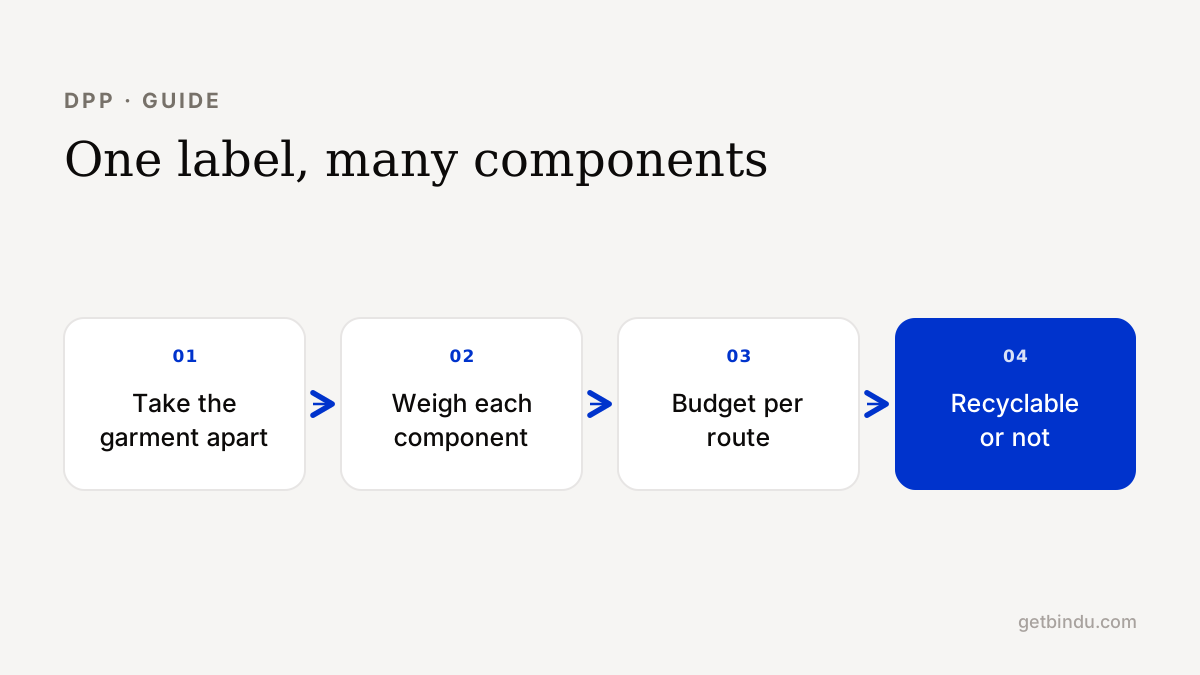
The guidance reads a garment in four levels. One level is not enough. The main fabric is the largest part. It has the main surface area. In the guidance's words, "this is generally the part of the garment that will be recycled". Secondary fabrics are small parts inside or outside. They are "usually not detected during sorting". Soft trims and prints are also "usually not detected during sorting and cannot be removed during de-trimming". Hard trims "can normally be removed during de-trimming".
The design rule for the main fabric is one sentence: "Select only 1 green material above the minimum threshold. If a blend is required, add only 1 light green or 1 yellow material below the maximum threshold".
Hard trims get the reverse rule: "All materials can be used because hard trims will be removed during de-trimming". It still says to "Reduce the use of hard trims to minimise waste". Removal costs material, in its own words: "De-trimming can result in significant material loss as some fabric often stays attached to the trims when removing them".
Recyclability is a weight budget, not a property
No garment has a property called recyclable. A route has a tolerance, and your bill of materials either fits inside it or it does not.
Elastane is the clearest case. T-REX gives a weight limit per route, measured at garment level.
| Recycling route | Recycler | Elastane, share of garment weight |
|---|---|---|
| Cotton | Infinited Fiber | 0 to 5 percent |
| Polyester | CuRe Technology | 0 to 5 percent |
| Polyamide 6 | BASF | 0 to 20 percent |
The middle row carries its caveat again. The CuRe column is a projection for a commercial scale plant still in the planning phase.
A legging at 6 percent elastane falls outside the cotton route, yet the same legging sits inside the polyamide 6 route. Nothing about the garment changed. The route did.
Take the hoodie, for example. It runs 97.1 percent cotton and 0.8 percent elastane. Then 2.0 percent polyester and 0.1 percent removable. The elastane sits in the rib cuffs because taking it out "would reduce durability. As a result, elastane was added to keep the cuffs in shape".
A legging runs 92.3 percent polyamide 6. It carries 5.9 percent elastane. Its note reads: "A minimum of 6% elastane is needed for the main fabric to achieve the desired product purpose". T-REX then clears it, because it "stays below the recommended thresholds, it won't harm recycling".
The detachable trim myth
Designers reach for detachable trims early. T-REX puts that idea down: "Detachable trims are often considered better for recyclability. In reality, they don't have much impact as industrial scale pre-processors don't have time to manually check and remove detachable trims".
Sorting also misses what it cannot see. Blends make near infrared scanning less accurate. Finishes and coatings cannot be detected at all. NIR "only scans specific points". So a part of a different make-up goes unseen. It also "only scans the garment surface". So a multilayer garment reads wrong.
Two-material blends can sometimes be sorted and recycled, if the thresholds hold. Blends with elastic fibres are hard to detect. "Blends of three or more materials can often not be accurately detected in sorting and can cause contamination of feedstock". Each trim or print has to come off. That holds for any part that does not match the main fabric. Removal "can result in a significant increase of processing waste".
What the trade-off costs the wearer
Removing a disrupter can make a worse garment. D3.1 says it directly: "the exclusion of elastane facilitates recycling but reduces stretch and wearer comfort, which may negatively affect product lifetime or user acceptance".
A T-REX policy white paper from February 2025 says the same. It is a readout of one roundtable. That roundtable met in Brussels on 12 November 2024. The room gathered stakeholders from across the value chain "along with EU policymakers and research institutes". So it records a room, not a research finding. Its line: "While the current trend promotes mono-material compositions to enhance recyclability, this approach may compromise the durability and functionality of textile products".
Where the law actually stands
None of this is law. Both documents are research output. T-REX says its guidance "is intended as a report from a research project and should not be used for any commercial purposes". Its toolbox covers single layer garments only. Coatings and finishes are untested. So are graphic prints and multilayer garments.
The binding law is ESPR, Regulation (EU) 2024/1781, which sets the frame for ecodesign rules and for the product passport. The rules arrive per product group, carried by delegated acts.
The textile act has not been adopted. The Commission adopted its ecodesign and energy labelling working plan on 16 April 2025. That plan ranks textiles and apparel first in the queue. The Commission's textile apparel passport page sets a planned date of Q4 2027 for adopting that act, and says the timing may still move. Nothing in EU law asks for a mono-material build today.
For the mechanics, see what ESPR is and what a digital product passport is. The field groups sit in a textile passport.
So replace that line in the brief with three. Name the route. State the main fabric. Give its share of garment weight. List each disrupter by weight. Mark the ones that are embedded.
Where Bindu fits. Bindu holds the bill of materials as a weight budget. Each part carries its share and its route verdict. There is no single yes or no on the garment. A delegated act will set the textile field list. Those same records then fill the textile passport template.
FAQ
Is mono-material clothing required by EU law? No. ESPR sets the frame, and ecodesign rules come from delegated acts that arrive per product group. The textile act has not been adopted. So no ecodesign rule for clothing is in force. The Commission's textile apparel passport page gives a planned date of Q4 2027 for adopting it.
Source: Regulation (EU) 2024/1781
How much elastane can a recyclable garment contain? It depends on the route. The limit is a share of garment weight. T-REX gives 0 to 5 percent for cotton. It gives 0 to 5 percent for polyester. For polyamide 6 it gives 0 to 20 percent. The polyester figures describe a plant still in the planning phase.
Source: T-REX Project
Do detachable trims improve recyclability? Less than designers expect. T-REX says they "don't have much impact as industrial scale pre-processors don't have time to manually check and remove detachable trims". Removal costs material too. Fabric stays attached to the trims.
Source: T-REX Project
How can a garment sold as mono-material contain 43 components? Because the claim covers the main fabric, not the whole build. One TRUSTex teardown looked at a waterproof jacket. It found coated fabrics, elastics, eyelets and buttons. It also found seam tapes, prints and electronic labels. That report is a draft, not yet validated by the granting authorities. The count covers a single garment.
Source: ECOSYSTEX publications