
What Is the Ecodesign for Sustainable Products Regulation?


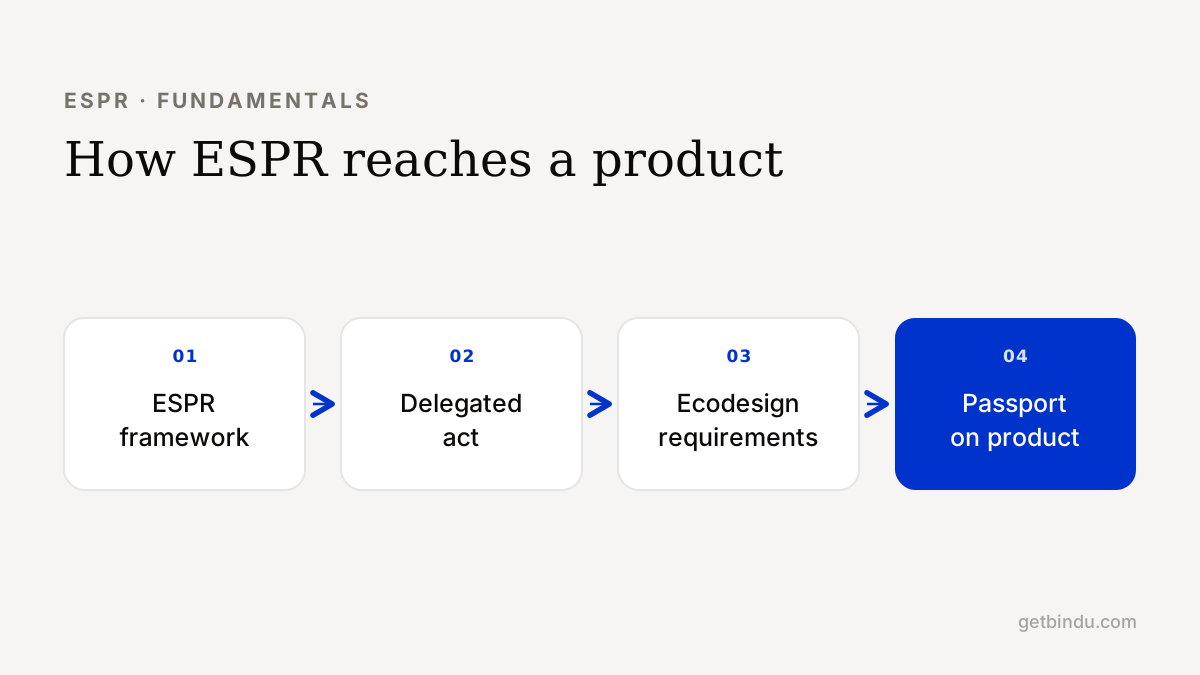
The Ecodesign for Sustainable Products Regulation (ESPR) is the EU law that sets design and data rules for almost every physical product sold in Europe. Its formal name is Regulation (EU) 2024/1781. It has been in force since 18 July 2024. The law sets no product rules by itself. It is a frame. The Commission fills that frame in, one product group at a time. It does that through smaller laws called delegated acts. The digital product passport comes from here. So does the ban on destroying unsold clothes.
At a glance:
- The ESPR is Regulation (EU) 2024/1781, in force since 18 July 2024.
- It replaced the 2009 Ecodesign Directive, which only reached energy-related goods.
- It now covers any physical good, apart from carve-outs such as food and medicines.
- Real duties arrive product by product, in delegated acts.
- An act normally gives at least 18 months before it bites.
- The product passport and the ban on burning unsold clothes both sit in this law.
Most people meet this law through one of its children. They read about a passport for a battery, or a ban on burning last season's coats. The parent law explains why those rules look the way they do.
From the old Ecodesign Directive to the ESPR
Directive 2009/125/EC is the 2009 frame that the ESPR replaced. It set ecodesign rules for energy-related goods. Boilers, lamps and fridges were the classic cases. Article 79 repealed it with effect from 18 July 2024.
The new scope is far wider. The ESPR reaches any physical good placed on the EU market. Parts and intermediate products count too. Only a short list is carved out. Food, feed, medicines and medicines for animals sit outside. So do living plants and animals, products of human origin, and plant and animal products used for breeding. Vehicles sit outside as well, but only for the aspects their own sector laws already handle.
Old rules do not vanish overnight. The Commission has kept a transition regime running while goods move across. Its own page puts the end of that regime at 2030.
What an ecodesign rule can demand
Ecodesign requirements are the design and data duties that a delegated act puts on a product group. Article 5 lists the product aspects those duties can improve. The list is long, and the words are plain.
| Product aspect | What a rule could ask for |
|---|---|
| Durability and reliability | A stated lifetime, or parts that survive normal wear |
| Reuse and repair | Spare parts, repair guides, easier disassembly |
| Upkeep and refurbishment | A design a service shop can open and restore |
| Substances of concern | Naming what blocks reuse or recycling |
| Energy, water and resource use | Less waste in use and in making the product |
| Recycled content | A share of recycled material in the build |
| Carbon and environmental footprint | A measured footprint, published or capped |
Two kinds of rule come out of that list. A performance rule sets a level the product must reach. An information rule sets facts the maker must publish. Most acts use both.
Article 5 also goes after early death by design. A rule can block choices that make a product age too soon. The text names weak parts, blocked disassembly, missing repair guides, and software that stops working after an update.
How the rules actually arrive
Delegated acts are the product-level laws the Commission adopts under the ESPR. Nothing binds a maker until one lands on their product group. Read the frame for the shape of a duty, and the act for the duty itself.
Article 4 puts a floor under the timing. An act cannot apply earlier than 18 months from the day it enters into force. There are narrow exceptions, for example where an act only amends an older one. So each new act needs two readings. One for the rules. One for the date.
The Commission says which groups are next in a working plan. The first ESPR and Energy Labelling Working Plan was adopted on 16 April 2025. It runs five years, with a review in 2028. Article 18 had already named the groups to put first. Iron and steel, aluminium, textiles, furniture and mattresses, tyres, detergents, paints, lubricants, chemicals, energy related goods, and ICT and other electronics are all on that list in the law.
Cement has its own clock. Article 18(6) says rules for cement must come no earlier than 31 December 2028 and no later than 1 January 2030. That deadline applies where construction products law has not covered its footprint.
The digital product passport
The digital product passport is the data tool the ESPR created. It is a record, reached from a data carrier on the product. It holds the facts the law wants shared along the chain.
Article 9 turns it into a condition of sale. Where an act calls for a passport, the goods can go on the market only if one is there. The data must be true, whole and current.
Each act writes its own passport rules. It fixes the data set, the data carrier, and where that carrier sits on the product. It says whether the passport is per model, per batch or per item. It says who may read each field, and who may write it. It sets how long the passport stays live. That period must cover at least the expected life of the product.
Annex III is the menu an act draws from. It offers the unique product code, commodity codes such as a TARIC code, conformity papers, manuals and safety notes. It also offers codes for the maker, for other operators and for sites.
The law builds shared plumbing too. Article 13 set a 19 July 2026 deadline for a passport registry, and it went live on 20 July 2026. A public web portal sits next to it.
Two passports are worth watching now. Textiles are a named priority. See the textile digital product passport explainer and its timeline. Batteries run on their own law, not on an ESPR act, as the battery passport guide sets out.
The ban on destroying unsold goods
Article 25 is the rule that bans the destruction of unsold consumer goods listed in Annex VII. It starts on 19 July 2026. This is the first hard ESPR date most brands will feel.
| Company size | When the ban applies |
|---|---|
| Large companies | 19 July 2026 |
| Medium-sized companies | 19 July 2030 |
| Micro and small firms | Not covered |
Annex VII is short today. It lists apparel and clothing accessories under commodity codes 4203, 61, 62, 6504 and 6505. Footwear follows under 6401 to 6405. The Commission can add groups later by delegated act, so check the list rather than learn it by heart.
A second duty sits next to the ban. Article 24 makes firms that discard unsold consumer goods publish what they threw away each year. The count, the weight, the reasons and the fate of the goods all go on an easy to find page of the website. Micro and small firms are out. Medium-sized firms join on 19 July 2030.
The Commission filled in the detail on 9 February 2026. One act sets out when textiles and footwear may still be destroyed. Safety is one such case. Goods that come back damaged beyond economic repair are another. A second act gives a standard reporting format, and that format applies from February 2027.
What to do before your product group is called
You cannot file an ESPR passport for most goods today. The fields are not written yet. The groundwork still pays.
Know what each product is made of. Know where those materials came from. Keep the evidence behind every claim, such as a supplier letter or a test report. Track which of your commodity codes show up in Annex VII and in the working plan. When your act lands, that work is the gap between a quick format job and a year of chasing suppliers.
Where Bindu fits. Bindu reads supplier papers into product records now. Material, origin and evidence data is then ready before an act fixes the format. See how the passport is built.

FAQ
What is the Ecodesign for Sustainable Products Regulation? It is Regulation (EU) 2024/1781. It is the EU frame law that lets the Commission set design and data rules for almost any physical product sold in the EU. It also creates the digital product passport and the ban on destroying unsold consumer goods.
Source: EUR-Lex: Regulation (EU) 2024/1781
Did the ESPR replace the Ecodesign Directive? Yes. Article 79 repealed Directive 2009/125/EC with effect from 18 July 2024. Transition rules keep parts of the old regime alive for goods already covered by it. The old directive reached only energy-related goods. The ESPR reaches physical goods in general.
Source: EUR-Lex: Regulation (EU) 2024/1781
Which products does the ESPR apply to? Any physical good placed on the EU market or put into service, including parts and intermediate products. Food, feed, medicines, medicines for animals, living plants and animals, products of human origin and breeding material are left out. Vehicles are left out for the aspects their own sector laws cover.
Source: EUR-Lex: Regulation (EU) 2024/1781
When do ESPR rules start to apply to my product? When the delegated act for your product group applies. Article 4 says such an act cannot apply earlier than 18 months from the day it enters into force, apart from narrow cases. The working plan adopted on 16 April 2025 sets out which groups come first.
Source: European Commission: Implementing the Ecodesign for Sustainable Products Regulation
Is the digital product passport part of the ESPR? Yes. The ESPR creates it. Article 9 makes it a condition of placing a product on the market wherever a delegated act calls for one. The data set and the data carrier for each passport come from that product group's own act.