
Green Claims Directive: Blocked, and What Applies Now

Your product page says eco-friendly, and the hangtag says it too. Someone in marketing wrote it two seasons ago. And no one has been asked to prove it since.
In the EU that one line is now a risk. Not for the reason that most articles give, though. The rule everyone searches for, the Green Claims Directive, never became law. A quieter directive did. Its national measures apply from 27 September 2026.
At a glance:
- The Green Claims Directive is still only a proposal, COM(2023) 166. The European Parliament's Legislative Train lists its status as "Blocked".
- The Commission said on 20 June 2025 that it intends to withdraw it. That withdrawal is not complete, so the file sits in limbo.
- Directive (EU) 2024/825, the Empowering Consumers directive, is in force. Its national measures apply from 27 September 2026.
- It catches generic wording such as eco-friendly, climate friendly and biodegradable. They are caught when you have no recognised excellent environmental performance to show.
- It also catches "climate neutral by 2030" promises. They are caught when no published, independently verified plan sits behind them.
Is the Green Claims Directive law? No
The Green Claims Directive is still just a Commission proposal. It would set rules for how you back up an explicit environmental claim, and for how you word it. It was published as COM(2023) 166 on 22 March 2023, under procedure 2023/0085(COD). A proposal is only a draft, and it binds no one.
It did get close. Parliament adopted its own first-reading position on 12 March 2024. The vote was 467 in favour, with 65 against and 74 abstentions. Talks with the Council then started in January 2025.
Then the whole file stalled. On 20 June 2025 the Commission said it would withdraw the proposal. The third trilogue, scheduled for 23 June 2025, was cancelled.
But stalled is not the same as gone. The proposal has not been formally withdrawn. The Commission Work Programme for 2026 still lists it as pending. That programme was adopted on 21 October 2025. The Parliament's Legislative Train entry now records its status as "Blocked".
So it is not in force, and it has not been repealed or withdrawn either. It may still be revived, or redrafted, or dropped.
The directive that applies from 27 September 2026
Directive (EU) 2024/825 is the EU law on empowering consumers for the green transition. Most people just call it EmpCo. It was adopted on 28 February 2024, and the Official Journal carried it on 6 March 2024. The directive itself is in force. It amends two older laws: Directive 2005/29/EC, the Unfair Commercial Practices Directive or UCPD, and Directive 2011/83/EU, the Consumer Rights Directive or CRD.
Its Article 4 is the one that sets the clock:
"By 27 March 2026, Member States shall adopt and publish the measures necessary to comply with this Directive. They shall immediately inform the Commission thereof. They shall apply those measures from 27 September 2026."
A directive is a law that binds each Member State to a result. That State then has to write the result into its own national law. So EmpCo never reaches your product page on its own. It gets there only through the national rules that transpose it. Those are, as a rule, the laws each country wrote to bring the UCPD into force. Expect the detail, the wording and the timing to differ from one country to the next.
| Green Claims Directive | Empowering Consumers (EmpCo) | |
|---|---|---|
| Short name | The green claims proposal | EmpCo |
| Status | Blocked proposal, COM(2023) 166 | In force as Directive (EU) 2024/825 |
| Instrument | Proposed directive, never adopted | Adopted directive amending the UCPD and the Consumer Rights Directive |
| What it covers | Substantiation and communication of explicit environmental claims | Named unfair practices: generic claims, empty future claims, weak labels, durability information |
| When it applies | No application date. Intent to withdraw announced 20 June 2025 | National measures apply from 27 September 2026 |
| How it is enforced | A dedicated verification regime, never enacted | National consumer protection authorities, under unfair commercial practices law |
What EmpCo bans
Generic environmental claims
A generic environmental claim is an environmental claim that meets two conditions. It is not included on a sustainability label. Its specification is not given in clear and prominent terms on the same medium. That is the test set out in the new Article 2(p) of the UCPD.
The ban sits in a different place in the text. Annex I to that directive gains a new point, 4a. It lists as unfair "Making a generic environmental claim for which the trader is not able to demonstrate recognised excellent environmental performance relevant to the claim". Recital 9 spells out the exact wording the drafters had in mind.
"environmentally friendly", "eco-friendly", "green", "nature's friend", "ecological", "environmentally correct", "climate friendly", "gentle on the environment", "carbon friendly", "energy efficient", "biodegradable", "biobased" or similar statements that suggest or create the impression of excellent environmental performance.
Read that list next to your own product copy. The words are not banned in themselves. They are banned when you cannot show what they imply.
And showing it is your job.
Promises about the future
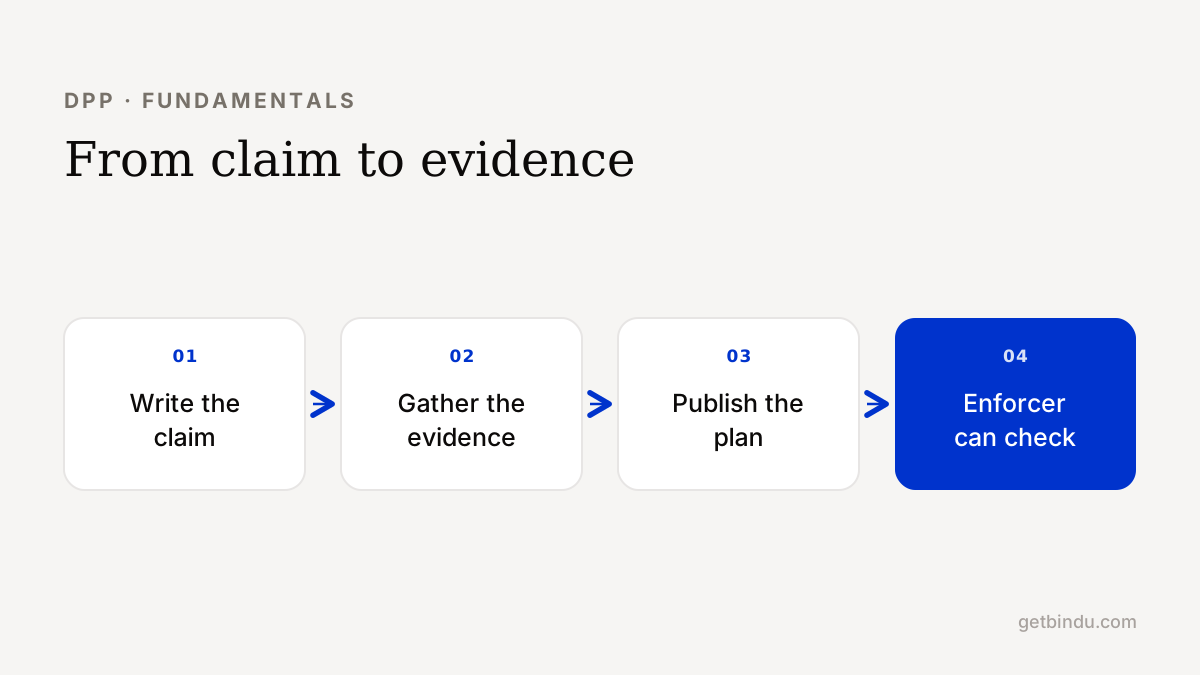
Article 6(2) of the UCPD has a new point, and it targets promises with nothing behind them. A claim about future environmental performance now needs "clear, objective, publicly available and verifiable commitments". Those commitments have to sit in "a detailed and realistic implementation plan". The plan needs "measurable and time-bound targets" and the resources to deliver them. It also has to be "regularly verified by an independent third party expert", "whose findings are made available to consumers". Publishing what the verifier found is a duty, not a courtesy.
"Climate neutral by 2030" stops being a slogan. It becomes a document you have to publish, and someone outside the company has to check it in public.
Labels you made yourself
A sustainability label is any voluntary trust mark, quality mark or equivalent, public or private. It sets a product, a process or a business apart by its environmental or social characteristics. That is Article 2(q). It excludes labels that Union or national law makes mandatory.
The ban itself sits in Annex I point 2a. Displaying a label "that is not based on a certification scheme or not established by public authorities" is unfair. Say your own team drew a green leaf badge, with no certification scheme and no public authority behind it. That badge is caught by the ban.
Durability and repairability
EmpCo also amends Articles 5 and 6 of the CRD, so traders owe the buyer clearer facts before the sale. That covers commercial guarantees, how long a product lasts and how easily it can be repaired. The ESPR points the same way, and so does the Digital Product Passport. Both of them turn product facts into published data, not adjectives.
A worked example
Take one jacket, for example, sold right across the EU. Then read its page claim by claim.
| The claim on the page | Why it is exposed | What EmpCo expects instead |
|---|---|---|
| "Eco-friendly jacket" | Generic wording off the Recital 9 list, caught by Annex I point 4a with no demonstrated excellent performance | A specific, substantiated claim about a specific aspect, or the word comes off |
| "Climate neutral by 2030" | A future performance claim with no published plan | A public plan with measurable, time-bound targets, verified by an independent third party, with the findings made available to consumers |
| An in-house green leaf badge | A self-made label with no certification scheme behind it, which is Annex I point 2a | A label from a certification scheme or a public authority, or no badge |
None of those three fixes is a copy edit. Each one is proof, and someone has to own it and keep it up to date.
Who checks a green claim now
Proof is policed through consumer law, and it is the national enforcers who ask for it. That happens case by case, and only once the claim is already out there. No one checks it before it goes to market. There is no accredited verifier, and no certificate to hold up.
The TRUSTex project reads the file the same way. Its report D1.2 carries the date 28 February 2026. It says the stalled proposal "leaves this regulatory approach partially fragmented, with substantiation requirements enforced primarily through consumer law rather than a dedicated verification regime". The report opens that sentence with the word "withdrawal". That reads the file more loosely than the record supports. So the quote here starts after that word. The report is a draft, not yet validated by the granting authorities. Treat it as research, and not as law.
Your proof has to be there before the claim goes live. No one asks you for it until a complaint comes in. One claim can land differently in Germany, the Netherlands and France, because each is enforced through its own transposing law.
So a green claim is really a paperwork problem. It belongs with the product file, not in a marketing folder, and the rest of trade compliance works the same way. Keep the claim, and keep the data behind it. Keep the date, and keep the name of the person who accepted it.
Where Bindu fits. Bindu keeps each product claim next to the evidence behind it. That means the source document, the date, and who signed it off. So an enforcement question has an answer on file. That data may have to become a public passport page. It then comes from the record. No one builds a fresh spreadsheet. See the Digital Product Passport breakdown.
FAQ
Is the Green Claims Directive law? No. It is only a Commission proposal, COM(2023) 166. The procedure is 2023/0085(COD). Parliament adopted a first-reading position on 12 March 2024. No directive was ever adopted. The Commission said on 20 June 2025 that it intends to withdraw it. That withdrawal is not complete. The Parliament's Legislative Train shows the status as "Blocked".
Source: European Parliament: Legislative Train, substantiating green claims
Has the Green Claims Directive been withdrawn? Not formally. The Commission said on 20 June 2025 that it would withdraw it. The third trilogue, scheduled for 23 June 2025, was then cancelled. The 2026 Commission Work Programme still lists the file as pending. That programme was adopted on 21 October 2025. It is blocked, not withdrawn.
Source: EUR-Lex: COM(2023) 166, the proposal on substantiating green claims
Which EU rule on green claims applies now? Directive (EU) 2024/825, the Empowering Consumers directive, adopted on 28 February 2024. Under its Article 4, Member States had to adopt measures by 27 March 2026. They apply them from 27 September 2026. It reaches you only through those national measures.
Source: EUR-Lex: Directive (EU) 2024/825
Can I still say eco-friendly on a product? Only where you can show recognised excellent environmental performance relevant to the claim. That is Annex I point 4a of the UCPD, as amended. Recital 9 of Directive (EU) 2024/825 names that wording. It also names green, ecological, climate friendly, biodegradable and biobased. Without that proof, the generic word is the problem.
Source: EUR-Lex: Directive (EU) 2024/825
Does a climate neutral by 2030 claim need a plan? Yes. A claim about future environmental performance needs commitments behind it. They have to be clear, objective, publicly available and verifiable, and they have to sit in a detailed and realistic plan. That plan needs measurable and time-bound targets, and an independent third party expert has to verify it. The verifier's findings then have to be made available to consumers.
Source: EUR-Lex: Directive (EU) 2024/825