
EUDR TRACES: Registration, Filing and Reference Numbers

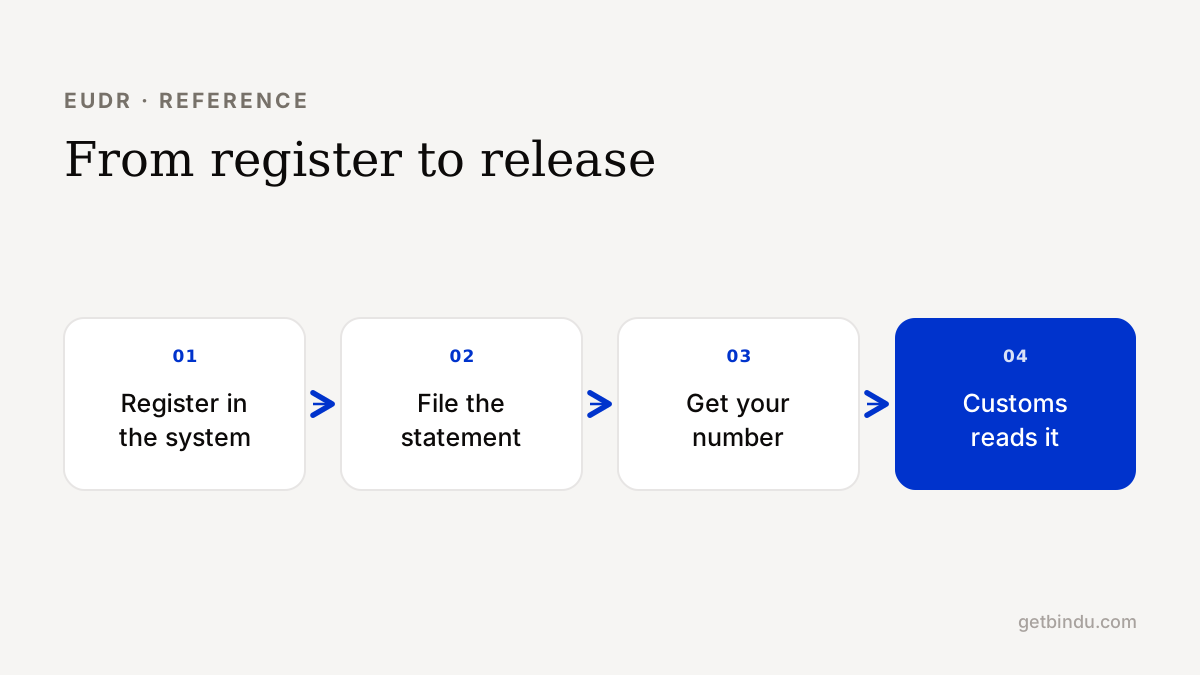
EUDR TRACES is the system where every EUDR filing lands. You register in it. You lodge your due diligence statement in it. It hands back the number that customs will ask you for.
One naming point first. The law never says TRACES. It says "the information system referred to in Article 33". TRACES is the Commission's trade system, and the EUDR part was built inside it. The law names a job. TRACES is the thing you log into.
At a glance:
- Article 33 sets up the system. TRACES is how the Commission built it.
- Operators file a due diligence statement and get a reference number.
- Micro and small growers file a one-time simplified declaration and get an identifier.
- Non-SME traders register, but file nothing at all.
- Customs reads the number before your goods move.
Who has to register
Registration and filing are two different duties. People mix them up all the time.
An operator is the first party to place a product on the EU market, or to export it. It registers and it files. A trader is anyone later in the chain who sells the goods on as they are. A downstream operator is a new role from December 2025. It covers firms that build a new product wholly out of goods that were already declared.
Regulation (EU) 2025/2650 added these registrations to the system's job list, under Article 5(2). Below the SME line, there is no registration at all.
| Who you are | Register? | File anything? | What you get |
|---|---|---|---|
| Operator | Yes | Due diligence statement | Reference number |
| Micro or small primary operator | Yes | One-time simplified declaration | Declaration identifier |
| Downstream operator, not an SME | Yes | Nothing | Nothing |
| Downstream operator, an SME | No | Nothing | Nothing |
| Trader, not an SME | Yes | Nothing | Nothing |
| Trader, an SME | No | Nothing | Nothing |
Registration is not a box to tick. It is how a competent authority builds its yearly plan of checks. It is also how it knows you exist.
What you file, and what comes back
There are two filings. There are two things you get back.
An operator files a due diligence statement under Article 4(2). It names the goods, the amount, the country they grew in, and where the plots are. It also says due diligence was done. The system then gives back a reference number. The operator keeps that record for five years.
A micro or small primary operator takes the short route in Article 4a. One declaration. Filed once. It carries the four fields in the new Annex III. What comes back is a declaration identifier, not a reference number. There is no form per shipment.
Both work the same way down the chain. Article 4(7) makes the operator pass its numbers to the firms it sells to. The first firm to get them keeps them. Firms further down do not.
A declaration identifier is to a small grower what a reference number is to an operator. Both show a filing exists. Both are what customs and your buyer will want.
How customs uses it
Here the system stops being paperwork and starts stopping goods.
Article 26(4) is the one to read. The reference number, or the declaration identifier, must reach customs before your goods are released or exported.
Before, not after. No number, no release.
Article 28(1) plans a shared link that moves data between national customs systems and the EUDR system by itself. That link is not live everywhere yet. Until it is, parts of Article 26 are switched off, and customs and the competent authorities work together by hand under Article 27. So how smooth your border is depends on how far your Member State has got.
A worked example
For example, consider a Finnish sawmill that sells sawn pine to a buyer in Spain.
The sawmill is the operator. It registers, files its statement, and gets a reference number. It hands that number to the Spanish buyer, because Article 4(7) says it must. The buyer has 300 staff, so it is not an SME. It registers too. It files nothing. It keeps the number, and the name of whoever it sells on to, for five years.
Now the goods leave the EU again. The number has to be with customs before export, not after it. If the sawmill never passed it on, the buyer has nothing to give. The goods wait.
That is the whole chain in one line. One filing, one number, many holders.
What the system does besides filing
Article 33 is longer than most people read. The new version lists more than storage.
It holds the register of firms that filed or registered. It feeds the risk scoring behind the plan of checks in Article 16(5), using past check results and the risk of each firm, crop and product. It also carries messages between a competent authority and the firms it supervises. The 2025 text says that may include digital supply tools, such as the systems you already run.
Article 33(4) says who gets in. Customs authorities, competent authorities, operators, downstream operators, traders, and their authorised representatives where they use one. Each sees what their own duties call for.
The plain reading is simple. This is not a filing cabinet. It is where the checks are aimed from, and your filings fill it.
Someone else can file for you
An operator may name an authorised representative to file for it under Article 6(1). The operator still carries the blame if the goods are wrong.
Article 6(3) goes further, and buyers should read it. An operator who is one person, or a micro firm, may name the next firm down the chain. That next firm must not be one person or a micro firm itself. Where that happens, the named firm may not sell or export the goods until it has filed on the grower's behalf.
So buying from very small growers can make you their filer. That is a duty, not a favour.
When this starts to bite
Article 38(2) sets 30 December 2026 for the core articles. That is when filing and registration start to matter for most firms.
Article 38(3) moves some parties to 30 June 2027. It reaches operators only, and only those that are one person, or a micro or small firm. They must also have been set up as such by 31 December 2024. Goods once covered by the old EU timber law annex are left out. Every trader and every downstream operator works to the 2026 date, whatever their size.
Register before you need to file. The EUDR timeline shows how both dates were reached.
Where Bindu fits. Bindu files to the system and hands back the number customs wants, next to the record for your file. It then carries that number to the firms downstream who must keep it. See the EUDR workflow.

FAQ
Is TRACES the same as the EUDR information system? In practice yes. The law only ever says "the information system referred to in Article 33", and the Commission built the EUDR part inside its own TRACES platform. See the Commission's information system pages.
Do I need to register if I am a small trader? No. Article 5(2) only reaches traders and downstream operators that are not SMEs. A small trader neither registers nor files. It must still keep its Article 5(3) records for five years.
What is the difference between a reference number and a declaration identifier? A reference number comes back when an operator files a due diligence statement. A declaration identifier comes back from the one-time simplified declaration that a micro or small grower files. Both go to customs. Both pass to the first buyer.
Does customs see my filing by itself? Not yet, everywhere. Article 28(1) plans a shared link between customs systems and the EUDR system. Until it is live where you ship, part of Article 26 does not apply and the authorities work by hand under Article 27.
Can a non-SME trader still file a due diligence statement? It does not have to. The December 2025 change took that duty off traders and off downstream operators. They keep the number from upstream instead of making their own.
How long do I keep what the system gives me? Five years. An operator keeps its statement record for five years from the day it filed. Traders and downstream operators keep their Article 5(3) records for at least five years from the day the goods moved.