
EUDR Simplified Declaration: Who Qualifies and What to File

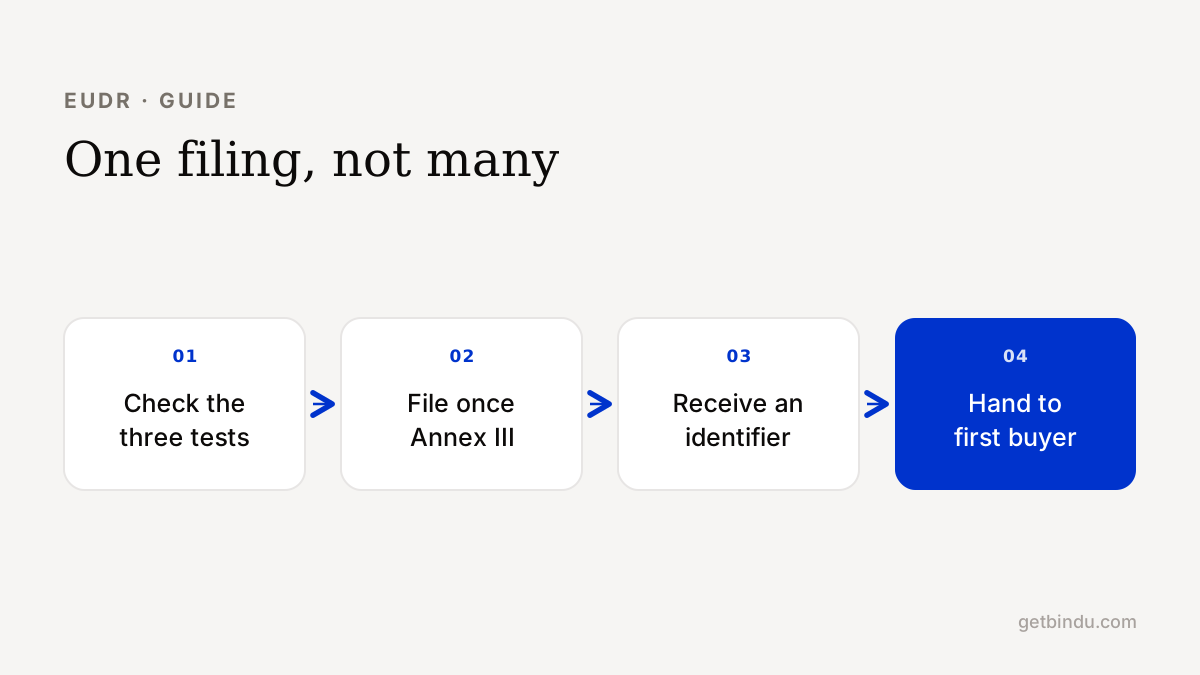
The EUDR simplified declaration is a one-time filing that takes the place of the due diligence statement for the smallest producers. You file it once, not per shipment. In return the system gives you a declaration identifier. That identifier travels with your goods, the way a DDS reference number would.
Regulation (EU) 2025/2650 created it as a new Article 4a. Not everyone may use it. The gate is narrow, and three things must be true at once.
At a glance:
- One filing, not one per shipment. Update it only after a big change.
- Three tests: you are micro or small, you are in a low-risk country, and you grew the goods yourself.
- You get a declaration identifier, which stands in for a DDS reference number down the chain.
- A postal address may replace geolocation, which is the biggest real relief in the whole change.
- Four fields to give, set out in the new Annex III.
Who qualifies
The test sits in Article 2, point (15a). It has three parts. Miss one and you file a full DDS instead.
A micro or small primary operator is an operator that meets all three. First, it is a natural person, or a micro or small undertaking under Directive 2013/34/EU, whatever its legal form. Second, it is established in a country classified as low risk under Article 29. Third, it places on the market or exports products that it grew, harvested, obtained from or raised itself, on its own plots of land, or for cattle on its own establishments in that country.
The third part is the one people misread. "Primary" means you produced the goods yourself. A small trader who buys and resells does not qualify, however small it is. Neither does a small processor.
| Test | What it means | Where it comes from |
|---|---|---|
| Size | Natural person, or a micro or small undertaking | Directive 2013/34/EU, Article 3 |
| Place | Established in a low-risk country | EUDR Article 29 |
| Production | You grew, harvested or raised it yourself | EUDR Article 2(15a) |
Low risk is not your call to make. It comes from the Commission's country list, first set out on 22 May 2025 in Implementing Regulation (EU) 2025/1093. That list puts every EU Member State in the low-risk tier. Only four countries sit in the high-risk tier. So a small Finnish woodland owner or a small Irish cattle farmer is the typical user of this route.
The alternative route for bigger companies
There is a second route in, and it is easy to miss.
A company may exceed the limits on two of the three criteria in Directive 2013/34/EU and still qualify here. It must show one thing. The parts of its balance sheet total, net turnover and staff count that relate to the covered commodities must stay under at least two of those three limits.
So a large mixed business with one small farming line may use this route for that line. You carry the burden of showing the split. The test looks at the EUDR part of the company, not the whole of it.
What you file
Article 4a(3) points at the new Annex III. Four items.
- Your name and address, plus your EORI number where goods cross the EU border.
- A Harmonised System code and a free-text description of the products, including the trade name. Then a one-off estimate of the annual quantity you intend to place on the market or export, expressed in net mass, with a percentage estimate or deviation. Volume or a number of items where that fits better.
- The country of production, and the location of your land. Either the geolocation of every plot, or the postal address of the establishment or of all the plots. For cattle, the address or geolocation of every establishment where the animals are kept.
- A prescribed confirmation, printed in Annex III, in which you confirm you will exercise due diligence, and will only place or export products where no risk, or only a negligible risk, is found.
Note what is absent. No risk assessment to attach. No supplier chain to map. You are the start of the chain.
Postal address in place of geolocation
This is the clause worth reading twice. Article 4a(5) says that for micro or small primary operators, the geolocation in Article 9(1), point (d), may be replaced by the postal address of all plots, or of the establishment.
Geolocation has been the hardest part of EUDR for small producers. Article 2(28) sets it as latitude and longitude to at least six decimal places. It also calls for polygons on plots over four hectares, where the crop is not cattle. A postal address needs none of that. No mapping software. No survey. No consultant.
Two cautions. The relief only reaches producers who pass the Article 2(15a) test. And it covers the declaration, not the duty behind it. You must still be able to show your goods are deforestation free.
What no longer applies
Article 4a(1) switches off three duties by name. You do not file a due diligence statement under Article 4(2). You do not keep the five-year record of statements in the second sentence of Article 4(3). You do not carry Article 4(4), point (c).
What remains is the substance. You are still responsible for the goods meeting Article 3. The paperwork shrank. The prohibition did not.
If the information is already held
Article 4a(4) adds a quiet exemption. Where all the Annex III data already sits in a system set up under EU or national law, you file nothing. Your Member State puts it into the EU system for you.
One condition still bites. You may only place or export once a declaration identifier has been assigned to you. No identifier, no sale, however complete the national database is.
A worked example
For example, consider a Finnish woodland owner with 30 hectares, four employees, and no other business.
She passes all three tests. She is a small undertaking. Finland is low risk. She fells her own trees. So she files one simplified declaration. It carries her name, address and EORI number. It gives the HS code for her sawn wood, a yearly estimate of 900 tonnes with a deviation, and the postal address of her woodland. No polygons. The system assigns her an identifier. She hands it to the mill that buys from her, and files nothing again that year.
Now change one fact. She starts buying logs from a neighbour and reselling those as well. Those logs are not her own crop. For them she is not a primary operator, so the short route shuts, and a full statement with geolocation is due.
One bought-in log changes the route. That is the test in practice, such as it is.
Your dates
The simplified regime does not move the calendar by itself. Article 38(3) does that.
Operators that are natural persons, or micro or small undertakings, move to 30 June 2027. But only where they were established as such by 31 December 2024. Products once covered by the annex to the old EU Timber Regulation are excluded from that deferral. Everyone else, including every downstream operator and trader, works to 30 December 2026.
So a producer set up in 2025 gets no extra time. The full EUDR timeline lays out both dates and the two delays behind them.
Where Bindu fits. Bindu works out whether a producer passes the Article 2(15a) test. It gathers the four Annex III fields, and files once rather than per consignment. It then carries the identifier to the first buyer. See the EUDR workflow.
FAQ
Is the simplified declaration the same as a due diligence statement? No. It stands in for the DDS for those who qualify. A DDS is filed per consignment or per period and returns a reference number. A simplified declaration is filed once and returns a declaration identifier.
How often must I file it again? It is a one-time filing. Article 4a(3) lets you update it after any material change, such as a new plot or a much larger yearly amount. There is no renewal.
Can a small trader use the simplified declaration? No. The route is only for primary operators, meaning producers who grew, harvested or raised the goods themselves. A trader of any size falls under Article 5 instead, next to downstream operators.
Do I still need geolocation? Not in the declaration. Article 4a(5) lets a producer who qualifies give the postal address of its plots or establishment instead. The relief only reaches micro or small primary operators.
What does my buyer need from me? Your declaration identifier. The first downstream operator or trader after you keeps it, just as they would keep a DDS reference number. Customs sees it before release for free circulation or export.
What if my country is not ranked low risk? Then this route is shut to you, whatever your size, and a full due diligence statement is due. Country classification comes from the Article 29 benchmarking list, which the Commission reviews and can change.