
EUDR Timeline: Deadlines, Delays and Current Dates


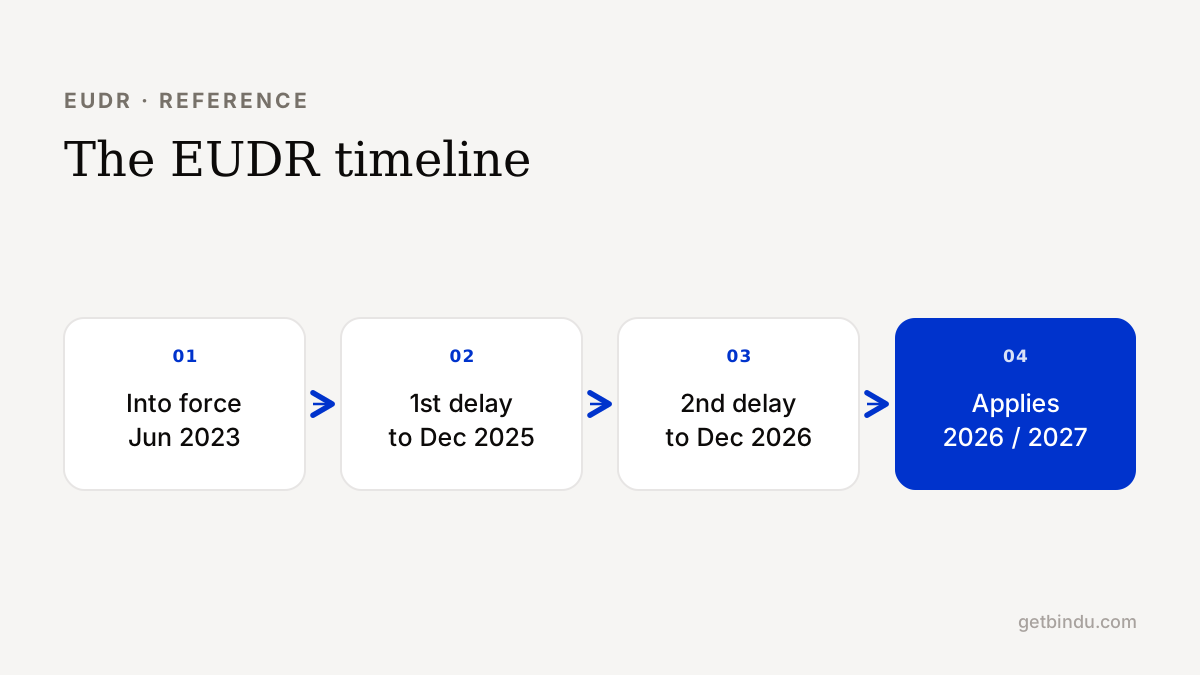
The EUDR is the EU Deforestation Regulation, Regulation (EU) 2023/1115. It is in force, but its core obligations do not apply yet. Its timeline has moved twice since the regulation was adopted. The current EUDR deadline is 30 December 2026 for large and medium operators and traders, and 30 June 2027 for micro and small enterprises.
Updated 27 August 2026. Most of the deadlines still circulating online are stale.
Ignore the 2024 and early-2025 dates. They were real once. They are not the dates that bite now.
At a glance:
- In force since 29 June 2023, under Regulation (EU) 2023/1115.
- Applies from 30 December 2026 for large and medium operators and traders.
- Applies from 30 June 2027 for micro and small enterprises and natural persons.
- Delayed twice, by Regulation (EU) 2024/3234 and Regulation (EU) 2025/2650.
- Not postponed again: the 4 May 2026 review left both dates unchanged.
Is the EUDR delayed?
Yes. Twice.
The EUDR was adopted in 2023 with two original application dates. Large and medium companies faced 30 December 2024. Micro and small ones faced 30 June 2025. Neither of those dates is live any more.
The first delay came in December 2024. The second came in December 2025 under Regulation (EU) 2025/2650. Each pushed the whole thing back by a further twelve months. So the obligations that were meant to start biting at the end of 2024 now start at the end of 2026.
The regulation itself has been in force since 29 June 2023. In force is not the same as applying. Entry into force is the point where the law legally exists and its counting periods start. The application date is the day the due-diligence, prohibition and TRACES-declaration duties actually bind you. That gap is the whole reason this page exists.
When does the EUDR come into force?
It already did, on 29 June 2023, twenty days after publication in the Official Journal. Nothing has changed that date and nothing will. When people ask "when does the EUDR come into force", they almost always mean "when does it start applying to me". That is the date that has moved.
The EUDR timeline, date by date
- 31 May 2023: the EUDR is adopted as Regulation (EU) 2023/1115.
- 9 June 2023: published in the Official Journal of the EU.
- 29 June 2023: entry into force, twenty days after publication.
- 30 December 2024: the original application date for large and medium operators and traders. Superseded. Do not plan against it.
- 30 June 2025: the original application date for micro and small enterprises. Superseded.
- 23 December 2024: first delay. Regulation (EU) 2024/3234 is published, postponing application by twelve months.
- 30 December 2025: the application date after the first delay for large operators. Also superseded, this time by the second delay.
- 30 June 2026: the post-first-delay date for micro and small enterprises. Superseded.
- 17 December 2025: the European Parliament adopts the second targeted revision.
- 23 December 2025: second delay. Regulation (EU) 2025/2650 is published in the Official Journal.
- 26 December 2025: Regulation (EU) 2025/2650 enters into force.
- 30 April 2026: deadline for the Commission's mandated simplification-review report.
- 4 May 2026: the Commission delivers its EUDR review report, COM(2026) 191 final, with a simplification package. The application dates are left unchanged.
- 30 December 2026: the current EUDR deadline for large and medium (non-SME) operators and traders.
- 30 June 2027: the current EUDR deadline for micro and small enterprises and natural persons.
The current EUDR deadline for large companies vs SMEs
There is not one EUDR deadline. There are two, split by company size.
- Large and medium operators and traders, the non-SMEs, must comply from 30 December 2026. From that day, you cannot place a covered commodity on the EU market, or export it, without a due-diligence statement lodged in TRACES.
- Micro and small enterprises, and natural persons get an extra six months, until 30 June 2027.
A due-diligence statement is the declaration you lodge in TRACES to show a shipment is deforestation-free and legal before it enters the EU market.
Company size is decided by the standard EU thresholds for micro, small, medium and large undertakings (Recommendation 2003/361/EC), not by an EUDR-specific test.
| Category | Staff headcount | Turnover | Balance sheet total |
|---|---|---|---|
| Micro | < 10 | ≤ €2m | ≤ €2m |
| Small | < 50 | ≤ €10m | ≤ €10m |
| Medium | < 250 | ≤ €50m | ≤ €43m |
| Large | ≥ 250 | > €50m | > €43m |
A company only needs to meet two of the three thresholds in a category to qualify for it. For example, take a coffee importer with 180 staff, €60m turnover and a €45m balance sheet. It sits under the 250-staff line, but it crosses both the turnover and balance-sheet limits, so it counts as large. Its deadline is 30 December 2026, not June 2027.
If you sit close to a boundary, or your group structure is complicated by linked or partner enterprises, assume the earlier date, 30 December 2026, and work back from it. Getting classified as large a year late costs a lot more than treating a borderline case as large from the start.
Why has the EUDR been delayed twice
Neither delay changed what the EUDR requires. Both changed when it starts requiring it.
The same readiness problems sit behind both postponements. The country benchmarking system grades sourcing countries as low, standard or high risk, and it was not finished. National competent authorities and the EU's own TRACES declaration system were not ready to receive due-diligence statements at scale. Operators, especially smaller ones deep in agricultural supply chains, had not had time to map plots of land back to shipments. Trading partners outside the EU also raised concerns about readiness on their end.
The second delay, Regulation (EU) 2025/2650, paired the extra time with simplification rather than issuing a bare postponement. That combination of more time plus a lighter regime for lower-risk cases is the signal that the Commission expects the December 2026 date to hold rather than slip a third time. It is not a guarantee.
What changed in the second delay besides the dates
Regulation (EU) 2025/2650 did more than move the calendar. It also simplified the regime.
Downstream operators and traders get lighter obligations. So does a new category of small and micro primary operators in low-risk countries. The lighter regime includes a simplified declaration option and reduced re-diligence where goods have already been through due diligence upstream. The amendment also narrowed scope: certain printed products under HS heading ex 49, such as books, newspapers and printed pictures, were removed.
Some of these details flow from implementing and delegated acts that were still being finalised through 2026. Verify the specifics against the consolidated EUR-Lex text before you make a category-specific claim about your own goods. The delay and the two headline dates are settled. The fine grain of the simplified regime is still bedding in.
Country risk benchmarking and the TRACES system
Two operational pieces sit underneath the dates and are still moving as of August 2026.
The country benchmarking system classifies sourcing countries as low, standard or high risk. It sets how much due diligence each shipment needs. It continued to be built out through 2026. Treat any country's current risk category as expected rather than fixed until the Commission publishes the finalised list.
TRACES, the EU's existing sanitary and phytosanitary system, is also being extended to carry EUDR due-diligence statements. Its EUDR-specific functionality and go-live schedule for the wider user base were still rolling out through 2026. That is another reason to build your own evidence trail well ahead of the deadline rather than assume the filing step will be simple on the day.
Has the EUDR been postponed again?
Not as of 27 August 2026. The 4 May 2026 review report and its simplification package delivered guidance, a draft delegated act on product scope, and revised IT-system rules. They did not touch the application dates. The 30 December 2026 and 30 June 2027 dates stand.
They stand rather than being permanent. The Commission's review clause left room for a further legislative proposal "where appropriate", and additional simplification measures were still moving through 2026. So today's dates are the operative ones, and nothing currently in front of the legislature moves them.
What to do now, whatever your date
The delay is not a reason to stop. It is a reason to get the data pipeline right before it counts.
Whatever your deadline, the work is the same:
- Know which of your products fall under EUDR scope.
- Map each shipment back to its plot of land and country of production.
- Collect the geolocation coordinates for each plot.
- Confirm the goods are deforestation-free after 31 December 2020 and legal in the country of origin.
That evidence has to exist before you file the due-diligence statement. The extra year is time to collect it, and it runs out on 30 December 2026.
For the fuller picture, start with what the EUDR is, then the practical EUDR compliance walkthrough. If you move coffee, the coffee importers guide works a real commodity end to end.
Where Bindu fits. The delay does not make the port moment go away; it gives you time to be ready for it. Bindu checks each shipment's CN code against EUDR scope and opens the template pre-filled from your own supplier data. It tracks the timeline against the regulation text, so the dates you plan around come from the law, not a stale summary. See how it works.

FAQ
Is the EUDR delayed? Yes. The EUDR has been delayed twice. After Regulation (EU) 2025/2650, the current application dates are 30 December 2026 for large and medium operators and traders, and 30 June 2027 for micro and small enterprises and natural persons.
Source: EUR-Lex: Regulation (EU) 2025/2650
When does the EUDR come into force? The EUDR entered into force on 29 June 2023, twenty days after publication in the Official Journal. That date has not changed. What moved is the application date, when the due-diligence and declaration obligations actually bind.
Source: EUR-Lex: Regulation (EU) 2023/1115
What is the EUDR deadline for large companies versus SMEs? Large and medium (non-SME) operators and traders must comply from 30 December 2026. Micro and small enterprises and natural persons have until 30 June 2027, a further six months.
Source: European Commission: EUDR implementation
Has the EUDR been postponed again? Not as of 27 August 2026. The Commission's 4 May 2026 review report and simplification package delivered guidance and draft acts but did not change the application dates. The 30 December 2026 and 30 June 2027 dates stand.
Source: EUR-Lex: Regulation (EU) 2025/2650
What happens if I miss the deadline? Once the EUDR applies to you, placing a covered commodity on the EU market or exporting it without a valid due-diligence statement is a breach. National authorities can impose fines of up to at least 4 percent of EU turnover, seize goods, and exclude you from public procurement. The date being delayed does not soften those penalties once it arrives.