
What Is an EUDR Downstream Operator? Duties and Dates

A downstream operator is a new EUDR role, created in December 2025. It covers anyone who places products on the EU market that were made using goods already declared upstream. A furniture maker buying declared sawn timber is one. So is a chocolate maker buying declared cocoa mass.
The role did not exist in the original law. Regulation (EU) 2025/2650 inserted it. If you used to think of yourself as an operator, you may not be one now.
At a glance:
- A new role since 26 December 2025, under Regulation (EU) 2025/2650.
- No due diligence statement to file, and no duty to check that anyone else did due diligence.
- Registration is still required if you are not an SME.
- Records on both sides of your chain, kept for five years.
- Your date is 30 December 2026, not June 2027. The later date is for operators only.
Who counts as a downstream operator
The test sits in Article 2, point (15b). A downstream operator places on the market or exports "relevant products made using relevant products, all of which are covered by a due diligence statement or by a simplified declaration".
Read the last part twice. The word "all" does the work. Every input must be declared already. If even one input arrives undeclared, you are not downstream. You are the operator for that product, and the full due diligence duty lands on you.
Three roles now share Chapter 2 of the law. They are easy to mix up.
An operator is the first party to place a relevant product on the EU market, or to export it. Article 2(15) was rewritten to add three words: "excluding downstream operators". A trader is anyone else in the chain who makes relevant products available on the market. A downstream operator sits between them. It takes a product that was declared and turns it into something else.
| Role | Files a DDS? | Registers? | Keeps records? |
|---|---|---|---|
| Operator | Yes | Yes | Five years |
| Downstream operator, not an SME | No | Yes | Five years |
| Downstream operator, an SME | No | No | Five years |
| Trader, not an SME | No | Yes | Five years |
| Trader, an SME | No | No | Five years |
The pattern is worth saying plainly. Only operators file. Everyone keeps records. Registration depends on size.
What you no longer have to do
The law is blunt here. Neither downstream operators nor traders must ascertain that due diligence was exercised, or submit due diligence statements. That is a real cut. The original Article 5(1) went the other way: a non-SME trader was "considered as" a non-SME operator, and inherited the operator's articles wholesale.
Two things follow. You do not collect geolocation for plots you never touched. You do not run a risk assessment on the country of production.
You also do not get to ignore what you are told. That is the next section.
What you must still do
Article 5 is short, and all of it binds you. Seven paragraphs.
Hold the information before you sell. You may only place, make available or export a relevant product if you already hold the records below. Not afterwards. Before.
Register, if you are not an SME. Non-SME downstream operators and non-SME traders register in the information system first. SMEs need not register at all. The thresholds come from Directive 2013/34/EU.
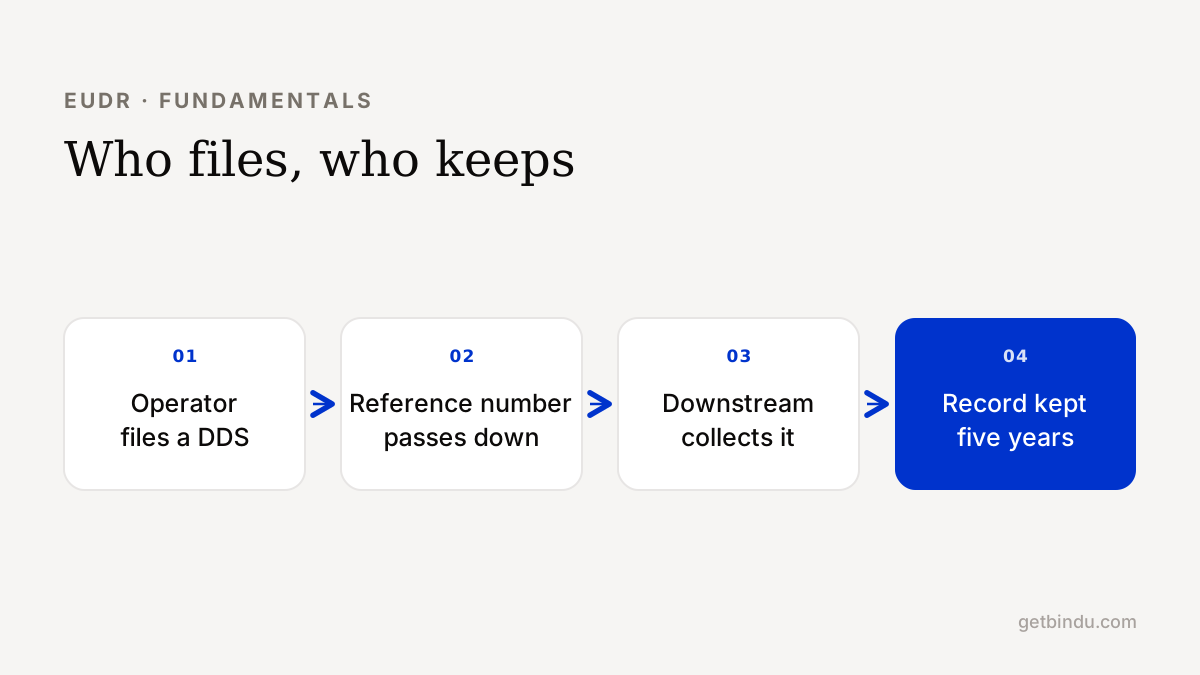
Keep records looking both ways. For every product you need the name, trade name, postal address, email and web address of whoever supplied you. Where that supplier is an operator, you also need the DDS reference numbers or declaration identifiers. Then you need the same contact details for whoever you supplied.
That second half catches people out. Most firms record their suppliers well and their customers loosely. The law wants both.
The words "where that supplier is an operator" matter more than they look. Reference numbers are collected by the first downstream operator or trader after the operator, and by nobody further down. For example, if you buy from another downstream operator, you record who they are and chase no number at all. Recital 6 says so in as many words, whatever your size.
Keep it for five years from the date you placed, made available or exported. Hand it over when a competent authority asks.
Act on red flags. If you learn that a product you already placed may not comply, you must tell the competent authorities at once. That means the authorities in each Member State where you placed it. You must also tell the downstream operators and traders you supplied. Silence is not an option.
If you are not an SME, there is more. Learn of a problem before you sell, and you must tell the authorities first. Where there are substantiated concerns, you have to verify that due diligence was exercised, and that no risk, or only a negligible risk, was found. You may not sell until that check comes back clean.
Help with checks. Give the authorities access to your premises and your papers.
The date trap
Most summaries get this wrong, so it is worth being exact.
Article 38(2) sets 30 December 2026 for the core articles. Article 38(3) then moves some parties to 30 June 2027. That shift is narrower than it looks. It reaches "operators, whether natural persons or micro- or small undertakings", and only those "established as such by 31 December 2024". It also leaves out products once covered by the old EU timber law annex.
So a small downstream operator does not get until June 2027. Nor does a small trader. The later date is for operators, and only some of them. If you are a downstream operator of any size, your date is 30 December 2026.
The EUDR timeline carries every date in the law's history, including both delays.
Checks and penalties
Being downstream does not make you invisible. Competent authorities check downstream operators and traders by examining the papers and records that show compliance with Article 5(1) to (4). Where that raises questions, they may add spot checks and field audits.
Member States must also hit yearly coverage targets, set by Article 16 as amended. For goods from high-risk countries, checks must reach at least 9 percent of operators, non-SME downstream operators and non-SME traders. The floor is 3 percent for standard risk and 1 percent for low risk. Checks arrive without warning.
Penalties reach you too. The amended Article 25 names fines, seizure of the products, and seizure of the revenue you earned on them.
A worked example
Consider a Dutch firm that buys kiln-dried oak from a German sawmill and makes tabletops.
The sawmill is the operator. It files the DDS and gets a reference number. Article 4(7) makes it pass that number to the firms it supplies. Our Dutch firm collects it, records the sawmill's details, records who it sells the tabletops to, and keeps the lot for five years. It has 120 staff, so it is not an SME, so it registers. It files nothing.
Now change one input. The firm adds a walnut inlay from a supplier who never declared it. Those tabletops are no longer made wholly of declared goods. For them, the firm is the operator, and owes a full DDS with geolocation.
One undeclared input flips the role. That is the whole test.
Where Bindu fits. Bindu tracks which inputs carry a reference number and which do not, so the role you are in is never a guess. It keeps the supplier and customer records Article 5 asks for, and holds them for the five years. See the EUDR workflow.

FAQ
Is a downstream operator the same as a trader? Almost. The law says their obligations are identical, and both sit in Article 5. The difference is what they do with the goods. A downstream operator makes a new product out of declared inputs. A trader passes the goods along as they are.
Do downstream operators need to file a due diligence statement? No. Neither downstream operators nor traders submit them, and neither must ascertain that due diligence was exercised upstream. You collect the reference number instead. See what an EUDR DDS is for what the operator files.
Does a small downstream operator get until 30 June 2027? No. Article 38(3) moves only operators that are natural persons or micro or small undertakings, and only where they were established as such by 31 December 2024. Downstream operators and traders of every size face 30 December 2026.
What happens if one of my inputs was never declared? You stop being a downstream operator for that product. The test needs all inputs covered by a due diligence statement or a simplified declaration. Without that, you are the operator and owe full due diligence.
Do I have to register? Only if you are not an SME. Non-SME downstream operators and non-SME traders register before placing, making available or exporting. The thresholds come from Directive 2013/34/EU, such as the staff, turnover and balance sheet limits in its Article 3.
What record actually matters most? The DDS reference number from your supplier, paired with the details of who you sold to. Those two together are what an inspector follows.