
EUDR Compliance: Requirements and How to Comply

A procurement manager at a chocolate maker opens a supplier email. Attached: a signed statement that the cocoa is "sustainably sourced, deforestation-free". It reads well. It is also useless.
There are no plot coordinates. No country breakdown. No way to check any of it against a satellite. When the EU's rules bite, that PDF will not clear a single consignment through customs.
EUDR compliance is not a promise you collect from a supplier. It is a due-diligence process you carry out, conclude, and file yourself, as a formal statement to the EU, before the goods move.
At a glance:
- EUDR compliance means filing a Due Diligence Statement in the EU's TRACES system before covered goods move.
- It covers seven commodities: cattle, cocoa, coffee, oil palm, rubber, soya and wood, plus many products derived from them.
- Operators run the due diligence and file the DDS. Traders mostly pass on DDS reference numbers.
- Goods must be deforestation-free after 31 December 2020 and legally produced in the country of origin.
- Core obligations apply from 30 December 2026 for non-SMEs, and 30 June 2027 for micro and small enterprises.
What is EUDR compliance?
EUDR compliance is your own proof, filed before you place a covered commodity on the EU market or export it, that the goods are deforestation-free and legally produced. You reach that conclusion through due diligence, then file it as a Due Diligence Statement in the EU's TRACES system. The rule is Regulation (EU) 2023/1115, the EU Deforestation Regulation. The European Commission's EUDR pages run the implementation.
The regulation covers seven commodities: cattle, cocoa, coffee, oil palm, rubber, soya and wood. It also covers a long list of products derived from them, such as leather, chocolate, furniture, paper and tyres. If what you trade sits inside that scope, you cannot lawfully move it across the EU border without due diligence behind it.
Compliance is your own conclusion, made against real data, that the goods carry a negligible risk of being linked to deforestation. Supplier certificates and attestations are inputs to it at most. That conclusion lives in a statement submitted to the EU before the goods are placed on or exported from the market.
For the plain-language version of the regulation itself, see what the EUDR is.
Who has to comply with the EUDR?
The regulation splits everyone who touches a covered commodity into two roles, and the roles carry different duties.
An operator is the first party to place the goods on the EU market, or to export them from it. That is the importer bringing green coffee into Hamburg, the trader first selling cocoa into the internal market. The operator carries the full weight: it must exercise due diligence and file the Due Diligence Statement.
A trader is anyone further down the chain who makes the goods available after they are already on the market. Large and medium traders carry duties close to an operator's, including collecting and keeping the DDS references of the goods they handle. Only micro and small enterprises acting as traders get the lightest regime. They mainly pass on the reference numbers of goods that were already covered upstream.
The SME versus non-SME line is the other split that matters, and the 2025 amendment sharpened it:
- Large and medium (non-SME) operators and traders carry the full obligations from 30 December 2026.
- Micro and small enterprises, and natural persons carry them from 30 June 2027, and get simplified duties. Downstream players get a lighter regime. Small or micro primary operators in low-risk countries get a simplified declaration option, with reduced re-diligence where the goods were already subject to due diligence upstream.
Producers, the farms and co-operatives that grow the commodity, do not file anything. Their job is to hand the operator clean plot boundaries, harvest records and legality documents so the operator can stand behind them.
Roles and duties line up as follows:
| Role | Who it is | Main duty |
|---|---|---|
| Operator | First to place the goods on the EU market, or to export them | Runs due diligence and files the DDS |
| Large or medium trader | Makes goods available further down the chain | Near-operator duties: collects and keeps DDS references |
| Micro or small trader | Smaller downstream player | Mainly passes on DDS reference numbers |
| Producer (farm or co-op) | Grows the commodity | Files nothing: supplies plot data and legality documents |
What are the EUDR requirements?
The EUDR requirements reduce to one obligation with three steps behind it. The obligation is the statement. The steps are the due diligence that lets you sign it honestly.
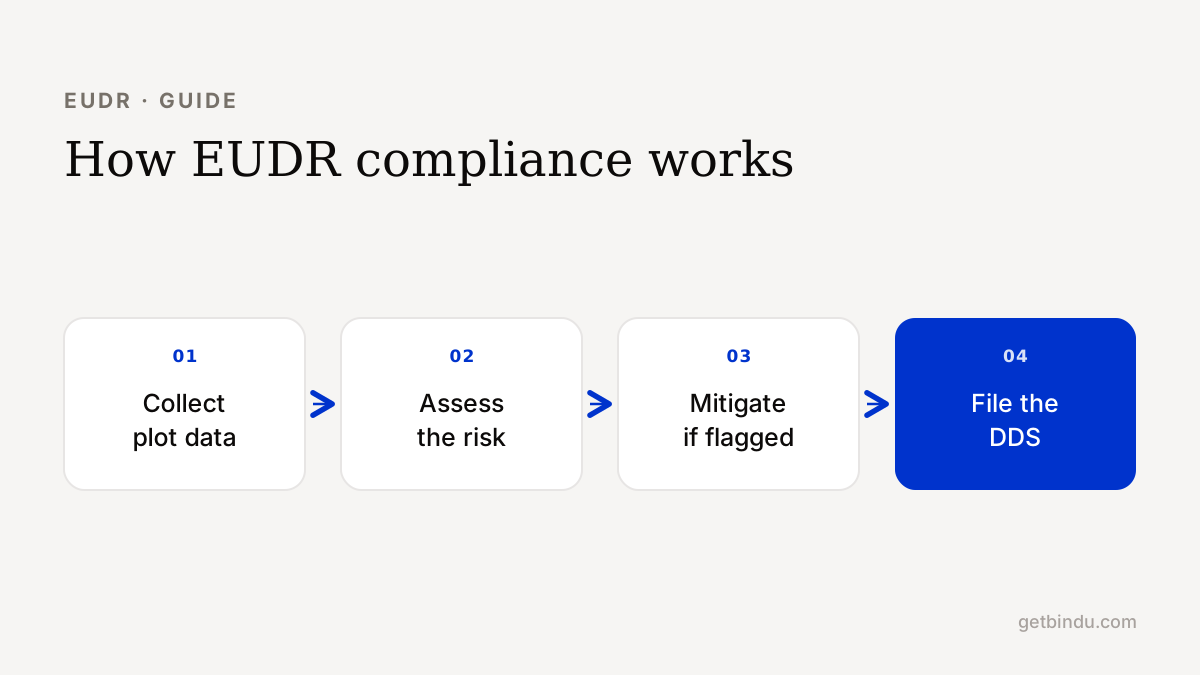
Article 8 of Regulation (EU) 2023/1115 sets the three-step spine of EUDR due diligence:
- Information collection. For each consignment, gather the commodity and its HS/CN code, the quantity in kilograms, the country of production, and the supplier and buyer details. Then comes the hard part: the geolocation of every plot of land where the commodity was produced. No sampling. Plots under 4 hectares are a single six-decimal point. Plots of 4 hectares or more must be traced as a polygon. Alongside the coordinates sits the legality evidence: land-use rights, harvest permits, tax and anti-corruption records.
- Risk assessment. Weigh that data against the risk that the goods are non-compliant. The EUDR risk assessment takes in the country's risk benchmark (low, standard or high), the presence of forests in the sourcing area, supply-chain complexity, and any reason to doubt the documents. The country benchmarking classification is an operational item still being finalised, so treat a country's status as expected rather than fixed until the Commission publishes it.
- Risk mitigation. Where the assessment finds more than a negligible risk, take steps to cut it back. Request more data, run independent audits, drop the plot, or split the shipment. You may only file once the residual risk is negligible.
A flag is a prompt to mitigate, not yet a verdict. You do not get to file until the risk is genuinely negligible, and you have to be able to show your working.
The two tests: deforestation-free and legally produced
Every consignment has to pass two tests before it clears. Miss either and the goods are non-compliant, however good the paperwork looks.
Deforestation-free means the commodity was produced on land that was not subject to deforestation after 31 December 2020. That cutoff is the hard edge. It does not reset when land changes hands. It does not care whether the clearing was legal locally. If the plot was forest on 31 December 2020 and cropland after, the goods fail.
Legally produced means the commodity complies with the relevant laws of the country of production. That covers land-use rights, environmental and forest rules, labour and human rights, tax, anti-corruption, trade and customs. Deforestation-free alone is not enough. A plot cleared before the cutoff still has to be lawful under local law.
EUDR traceability is what ties both tests to a real place. The geolocation coordinates are not bureaucracy for its own sake. They let an authority, or you, check the plot against satellite imagery and against local land records. Without traceability to the plot, neither test can be verified, and unverifiable is treated as non-compliant.
The EUDR deadlines that actually apply
Ignore the 2024 and early-2025 dates still circulating online. They have been superseded twice, and older articles are simply wrong.
As of August 2026 the EUDR is in force but not yet applying its core obligations. The prohibition, the due-diligence duty and the TRACES-declaration duty do not bite until these dates:
| Who | Core obligations apply from |
|---|---|
| Large and medium (non-SME) operators and traders | 30 December 2026 |
| Micro and small enterprises, and natural persons | 30 June 2027 |
Those dates come from Regulation (EU) 2025/2650, the second targeted revision. It was published in the Official Journal on 23 December 2025 and is in force from 26 December 2025. The revision postponed application by a further twelve months. It simplified obligations for downstream operators and traders, and for small primary operators in low-risk countries. It also removed certain printed products (HS heading ex 49, such as books and newspapers) from scope.
One caveat worth stating plainly. The Commission delivered its mandated simplification review report (COM(2026) 191 final) on 4 May 2026, with a guidance and simplification package, but that did not move the application dates. The 30 December 2026 and 30 June 2027 dates stand. For the full sequence, from adoption in 2023 through both delays, see the EUDR timeline.
What non-compliance costs
The penalties are set by member states, but Regulation (EU) 2023/1115 fixes the floor, and it is deliberately heavy.
- Fines proportionate to the environmental damage and the value of the goods, with a maximum of at least 4% of the operator's or trader's total EU-wide annual turnover (Regulation (EU) 2023/1115), raised if repeated.
- Confiscation of the goods and of the revenues gained from them.
- Exclusion from public procurement and from access to public funding for up to twelve months.
- A temporary ban on placing the relevant commodities on the market, plus the reputational hit of a published enforcement decision.
Non-compliant goods do not enter. Customs and competent authorities can stop a consignment where the DDS is missing, incomplete or false. A false statement carries its own liability.
A practical EUDR compliance checklist
If you are the operator, this is the short version of getting a consignment ready to file.
- Map your scope. Confirm which of your products carry a covered commodity and their HS/CN codes. Classification decides whether the EUDR applies at all.
- Identify your role and size. Operator or trader, SME or non-SME. That sets your deadline and how heavy your duties are.
- Collect plot geolocation. Coordinates for every plot, points under 4 ha, polygons at or above it. This is where most programmes stall.
- Collect legality evidence. Land rights, permits, tax and labour records for each sourcing area.
- Run the risk assessment. Country benchmark, forest presence, supply-chain complexity, document reliability.
- Mitigate any non-negligible risk. More data, audits, or dropping the plot, until the residual risk is negligible.
- File the DDS in TRACES and keep the reference number. Learn what an EUDR DDS is and what the DDS reference number does downstream.
- Keep the evidence for five years. Verification is retrospective; the file has to survive an audit.
Where Bindu fits. Collection is the work; the statement is the last five minutes. Bindu reads invoices, packing lists and supplier records into products and origins, and validates plot geolocation against the point-and-polygon rules. Legality evidence stays welded to the consignment for the five-year window, the DDS assembles from that record, and the legal conclusion stays yours to confirm. See how it works.

FAQ
What is EUDR compliance? EUDR compliance means carrying out due diligence and filing a Due Diligence Statement in the EU's TRACES system. The statement proves that a covered commodity is deforestation-free after 31 December 2020 and legally produced. You must file it before the goods are placed on or exported from the EU market, under Regulation (EU) 2023/1115.
Source: European Commission: Regulation on deforestation-free products.
What are the EUDR requirements? One obligation with three steps behind it: collect information including plot-level geolocation and legality evidence, assess the risk of non-compliance, and mitigate any risk above negligible, then file the Due Diligence Statement. The goods must pass two tests, deforestation-free and legally produced, and stay traceable to the plot.
Source: EUR-Lex: Regulation (EU) 2023/1115, Articles 8-10.
Who has to comply with the EUDR, operator or trader, SME or large? Operators, the first party to place goods on or export them from the EU market, carry the full duty and file the DDS. Large and medium traders carry near-operator duties; micro and small traders mainly pass on reference numbers. Non-SMEs comply from 30 December 2026, micro and small enterprises and natural persons from 30 June 2027 with simplified obligations.
Source: EUR-Lex: Regulation (EU) 2025/2650.
What is an EUDR due diligence statement? A Due Diligence Statement is the formal declaration an operator files in TRACES. It states the operator has done due diligence and found only a negligible risk that the goods are linked to deforestation after 31 December 2020. Until that statement clears, the goods cannot lawfully move across the EU border.
Source: EUR-Lex: Regulation (EU) 2023/1115, Article 4.
When is the EUDR deadline? The core obligations apply from 30 December 2026 for large and medium (non-SME) operators and traders. Micro and small enterprises and natural persons follow from 30 June 2027, under Regulation (EU) 2025/2650. The full sequence is in the EUDR timeline.
Source: EUR-Lex: Regulation (EU) 2025/2650.