
EUDR and Natural Rubber: Scope, Geolocation, and Proof

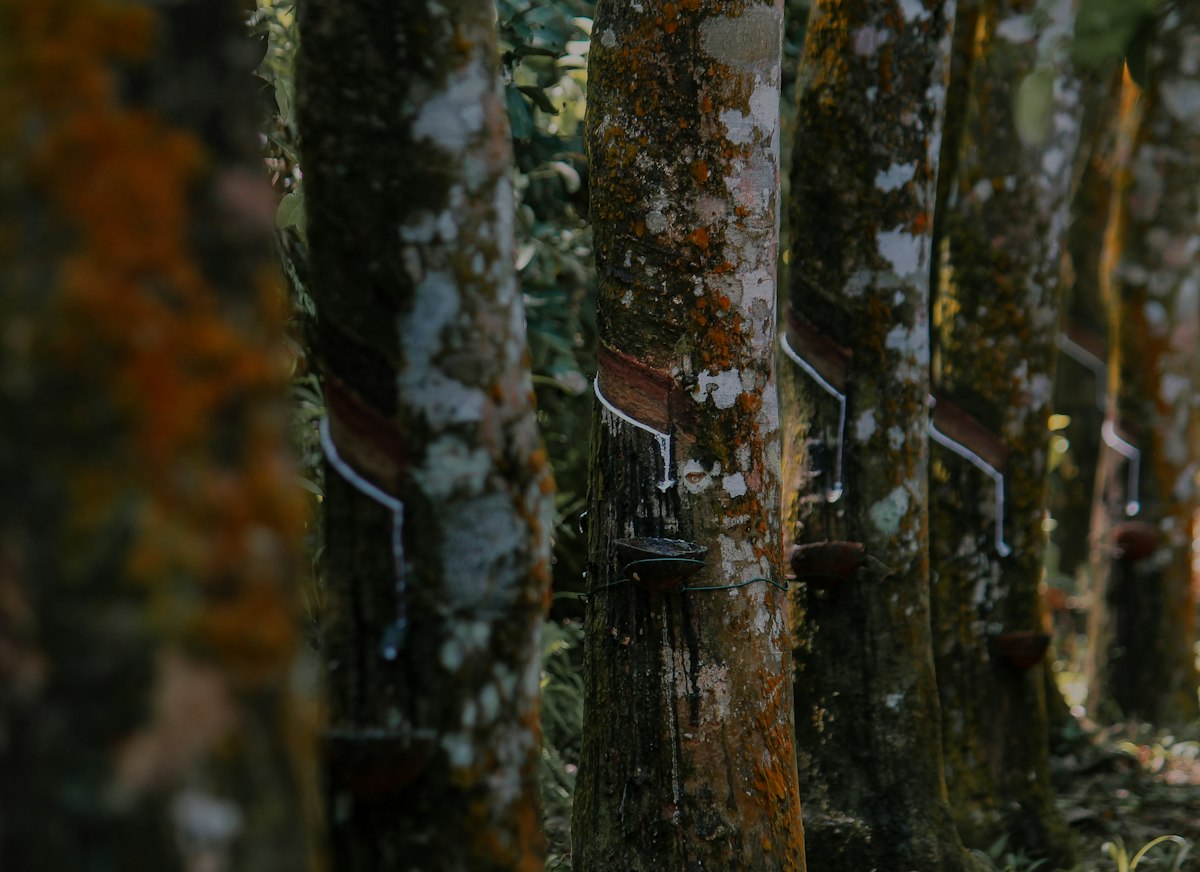
Rubber is the commodity most likely to catch importers off guard. A tyre is not obviously a farm product, but it is one, and the EU now treats it that way. The rubber in it started as latex tapped from a tree that grew on a specific plot of land, often a two hectare smallholding, often in a country where the same tree changed hands five times before it reached a port.
That chain is the problem. To place natural rubber on the EU market you have to prove where every drop came from and that the land was not cleared after a fixed date. For a supply chain that mixes latex from thousands of farms in one collection centre, that is a hard promise to keep.
This page explains what the EUDR covers for rubber, the geolocation and legality proof the law demands, and why traceability, not paperwork, is the real work.
At a glance:
- EUDR is Regulation (EU) 2023/1115, the EU Deforestation Regulation. Natural rubber is one of its seven commodities.
- Rubber sits in Annex I under CN Chapter 40. Latex, sheets, tyres, and gloves are all named, so finished goods are in scope, not just raw rubber.
- Every plot needs geolocation under Article 9: a single point under 4 hectares, a polygon at 4 hectares or more.
- Nothing you place can trace to land cleared after 31 December 2020, whether or not that clearing was legal locally.
- Large and medium operators must comply by 30 December 2026. Micro and small operators follow on 30 June 2027.
Is natural rubber covered by the EUDR?
Natural rubber is one of the seven commodities in scope of the EUDR, alongside cattle, cocoa, coffee, oil palm, soya, and wood. The rule is Regulation (EU) 2023/1115, and the exact products it covers are listed in Annex I by CN code.
For rubber, Annex I reaches well beyond the raw material. Natural rubber sits under CN heading 4001, and the annex then names derived products across Chapter 40: compounded rubber, sheets, tubes, conveyor belts, tyres under heading 4011, and gloves under heading 4015. So a tyre importer and a glove importer are both EUDR operators, even though neither buys a farm product that looks like one.
| Rubber product | Where it sits | In EUDR scope? |
|---|---|---|
| Natural rubber, latex, smoked sheets | CN heading 4001 | Yes, named in Annex I |
| Tyres, new pneumatic | CN heading 4011 | Yes, named in Annex I |
| Gloves | CN heading 4015 | Yes, named in Annex I |
| Synthetic rubber | CN heading 4002 | No, EUDR covers natural rubber |
That last row matters. The regulation is about natural rubber from trees, not synthetic rubber made from petroleum. If your product blends both, the natural share is what pulls it into scope. Check the CN code on the customs entry before you assume a rubber good is exempt. For how these codes work, see what is an HS code.
Why rubber is the hardest commodity to trace
Most compliance guides treat every commodity the same. Rubber does not behave like coffee or cocoa, and the difference is structural.
Smallholders dominate. In Thailand, the world's largest producer, around 90% of natural rubber comes from smallholders, roughly 1.68 million of them, farming an average of 2.3 hectares each, according to the Rubber Authority of Thailand. There is no single estate to map. There are millions of tiny plots.
Traders mix everything. Rubber passes through several layers of traders between the farm and the processor. They gather latex from many sources into one collection centre and mix it, and their transactions are often informal. Once mixed, the rubber has no single origin unless the inputs were recorded before they went in.
The frontier is moving. In Thailand, cultivation is shifting north and northeast onto new land, which raises the deforestation risk in exactly the regions with the least mapping. Land tenure is weaker there too, and a farmer without a land title often cannot be formally registered at all.
This is why national bodies are racing to map first. The Rubber Authority of Thailand has mapped more than 3.1 million hectares, about 79% of the country's rubber area, and geolocated 1.98 million plots into a central database it can compare against forest and protected-area maps. That mapping is the raw material an EU operator needs, but only if the geolocation and legality data travel with the rubber all the way down the chain.
What the law asks for, plot by plot
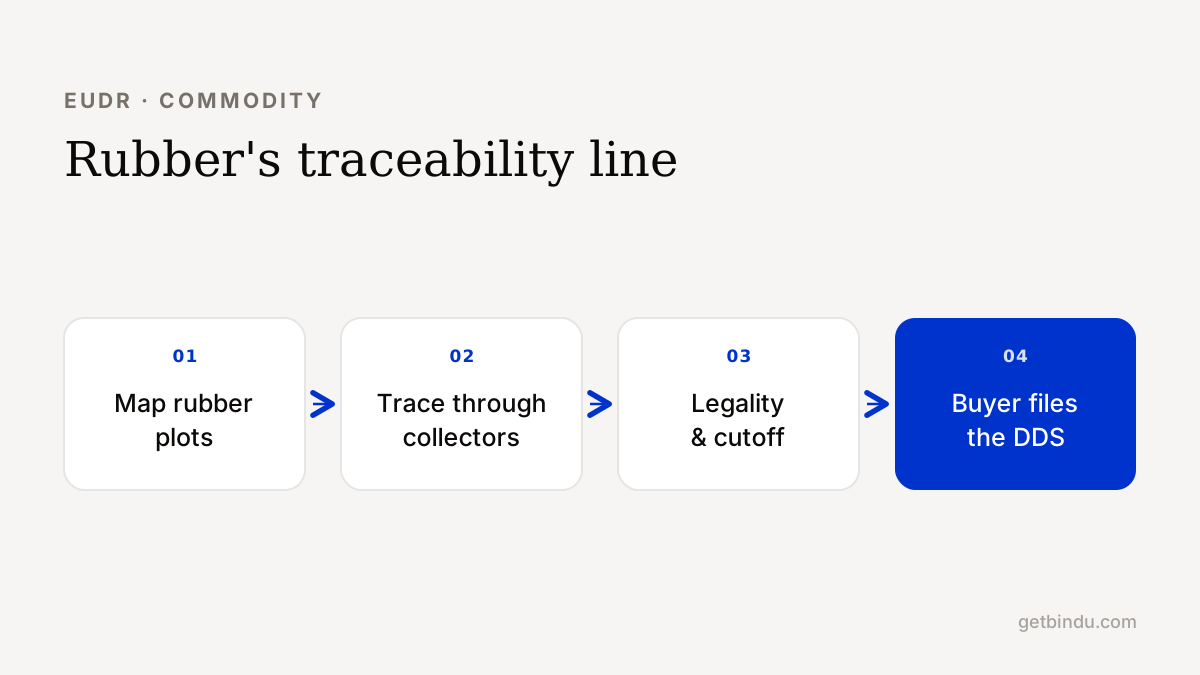
The EUDR does not ask for a certificate. It asks for three things about every plot the rubber came from, and they resolve into a single data package.
| Requirement | What it means for rubber | The rule |
|---|---|---|
| Geolocation | Coordinates for every plot the latex came from | Article 9: a point under 4 hectares, a polygon at 4 hectares or more |
| Legality proof | Evidence the rubber was produced lawfully | Article 2(40): land use, environment, forest rules, third-party rights, labour, human rights, FPIC, tax and trade |
| Cutoff status | Proof the plot was not cleared after the cutoff | 31 December 2020 |
Geolocation under Article 9 is the spine. Every plot, no sampling. Under 4 hectares, a single latitude and longitude. At 4 hectares or more, a polygon tracing the real boundary. For rubber that means coordinates for potentially thousands of two hectare smallholdings behind one shipment.
Legality under Article 2(40) is where rubber gets caught. The law lists the areas you must prove production was lawful against, and two bite hard in rubber country. Land use rights, because rubber grown in a national reserved forest needs a permit and often lacks one. Labour rights, because rubber sectors lean heavily on migrant workers whose permits and conditions must comply with local law. A GIZ analysis of Malaysian rubber and timber legislation maps these same areas, and finds land tenure and forest-reserve rules the hardest to evidence.
Under all of it sits the cutoff of 31 December 2020. Rubber tapped from a tree planted on land cleared after that date is non-compliant, even if the clearing broke no local law. That status does not reset when the plot is sold. This is what "deforestation-free rubber" actually means: a verifiable line back to land that was already planted, or already cleared, before the cutoff.
Who files, and who supplies the data
An operator is the party that first places rubber on the EU market, and only the operator files the Due Diligence Statement, the DDS. If you import tyres, latex, or gloves, that is you. Producers and traders upstream supply the geolocation and legality data; they do not file. For the filing itself, see what is an EUDR DDS, and for the number it produces, the EUDR DDS reference number.
This is the same handshake that coffee and cocoa buyers already run with their suppliers, described in EUDR for coffee exporters. The rubber version is harder only because the supply base is larger and the mixing is worse.
A worked example: one processor, thousands of plots
For example, take a processor that supplies latex to an EU glove maker. The latex comes from a collection centre that gathers from 4,000 smallholder plots. Most are under 4 hectares, so each needs a single GPS point. A handful are larger and need a polygon.
The processor maps every plot once and stores the coordinates. It checks each against the 31 December 2020 cutoff. Where a farmer holds a land title or a valid permit for reserved-forest land, it attaches the document, covering the Article 2(40) areas. It records which plots fed which batch at the collection centre, so the mixed output still traces back to mapped inputs. Then it hands the glove maker one data package, and the glove maker files one DDS.
Say 30 of those plots sit inside a reserved forest with no permit on file. Those plots are kept out of the batch, because one unverified input contaminates everything mixed with it. That is the edge case rubber lives with: the collection centre is where traceability is won or lost.
Where Bindu fits. The hard part of rubber is holding a clean line from thousands of small plots, through collectors who mix, to the batch you ship. Bindu maps each plot once, checks it against the cutoff by satellite, records which plots fed which batch, and lets you grant a buyer access to a data package without handing over every coordinate. See how it works.
FAQ
Is natural rubber covered by the EUDR? Yes. Natural rubber is one of the seven EUDR commodities, listed in Annex I under CN Chapter 40. The scope includes latex and smoked sheets under heading 4001, tyres under 4011, and gloves under 4015, so finished rubber goods are in scope, not just raw rubber. Synthetic rubber is not covered.
Source: EUR-Lex: EUDR, Regulation (EU) 2023/1115 (consolidated)
What geolocation do I need for rubber plots? Under Article 9, every plot the latex came from needs geolocation: a single point of latitude and longitude for plots under 4 hectares, and a polygon tracing the boundary for plots of 4 hectares or more. There is no sampling, so a shipment behind thousands of smallholdings needs coordinates for each one.
Source: EUR-Lex: EUDR, Regulation (EU) 2023/1115 (consolidated)
When must rubber importers comply? Large and medium operators must comply by 30 December 2026. Micro and small operators follow on 30 June 2027. The regulation was postponed twice, so ignore any 2024 or early-2025 date you may have seen. See the EUDR timeline.
Source: EUR-Lex: Regulation (EU) 2025/2650 (second postponement)
Why is rubber harder to trace than coffee? Because the supply base is larger and more mixed. Around 90% of natural rubber comes from smallholders farming a couple of hectares each, and traders combine latex from many farms in collection centres before it reaches a processor. Origin is preserved only if inputs are recorded before they are mixed.
Source: EUR-Lex: EUDR, Regulation (EU) 2023/1115 (consolidated)
Get rubber ready before December 2026
Rubber will not get easier to trace by waiting. The processors and importers that map their plots now, and hold origins through the collection centre, are the ones who will still be selling into the EU in 2027. Map your plots once, check them against the cutoff, package your legality, and hand your buyer a clean data package. Book a demo and be ready before the deadline.