
What Is a CBAM Report? Quarterly Reporting Explained

The last quarterly CBAM report fell due on 31 January 2026. An annual declaration takes its place from there.
The steel those reports covered landed months earlier. The mill that made it, in another country, never sent any emissions figures. And those figures, whatever they are, decide what the shipment costs once the charge begins.
That is the CBAM report in one picture: a filing about carbon you cannot see, from a supplier who may not answer.
At a glance:
- A CBAM report is a quarterly return on the embedded emissions of goods imported into the EU during the transitional period.
- The transitional period ran from 1 October 2023 to 31 December 2025. Reports carried no payment.
- Covered goods sit in Annex I: iron and steel, aluminium, cement, fertilisers, electricity, and hydrogen.
- The first report covered the last quarter of 2023. The last one was due 31 January 2026.
- From 1 January 2026 the definitive regime replaces quarterly reports with one annual declaration, and the charge begins.
What is a CBAM report?
A CBAM report is a quarterly return on the embedded emissions of goods imported into the EU. It exists because of the Carbon Border Adjustment Mechanism, the EU's carbon border charge under Regulation (EU) 2023/956.
Embedded emissions are the greenhouse gases released when the goods were produced, counted per tonne. For some goods, the report also captures indirect emissions from the electricity used to make them.
During the CBAM transitional period, from 1 October 2023 to 31 December 2025, importers of covered goods filed a report every quarter. There was nothing to pay and no certificates to buy. It was a data-gathering phase. The rules sat in Implementing Regulation (EU) 2023/1773.
The report was filed in the CBAM Transitional Registry, the EU's online system. The first report covered the last quarter of 2023. The last transitional report was due 31 January 2026.
Who had to file?
The reporting declarant is the party that owed the report. That was usually the importer of the goods. It could also be the indirect customs representative acting for them.
Covered goods are the ones in Annex I of the regulation: iron and steel, aluminium, cement, fertilisers, electricity, and hydrogen. If you brought any of these into the EU, you were a reporting declarant.
Annex I lists these goods by CN code. So whether a shipment counted came down to the code on the customs paperwork, not a judgment call. That is why classification sits at the front of any CBAM check.
Origin matters too. Goods from Iceland, Liechtenstein, Norway and Switzerland sit out of scope. Their carbon is already priced, so no report was needed. The carve-out is narrow. Almost every other origin was in scope.
What went in the report?
Each quarterly report set out a fixed set of fields, for every consignment. The table below shows what each field captured.
| Field | What it captured |
|---|---|
| Goods and CN code | The quantity of goods and the CN code for each line. |
| Embedded emissions | Direct emissions, and for some goods indirect emissions, per tonne. |
| Carbon price paid | Any carbon price already paid in the country of production. |
| Installation and method | The installation that made the goods, and the calculation method used. |
The CN code ties each line back to the HS code you already assign, so the report keys off data you hold.
Direct and indirect emissions are not the same thing. Direct emissions come from the production process itself. Indirect emissions come from the electricity a plant buys to run that process. For some goods the report asked for both. For others, it asked for direct emissions only.
Filling the form took minutes. Getting real emissions data out of suppliers took the quarter. The fallback default values stand in when a supplier gives nothing. They are set high on purpose. Leaning on them is rarely in the importer's favour, so the pull is always toward the real figure from the mill.
A worked example
For example, take a simple case. A trader imports a batch of steel from a mill outside the EU. Steel is an Annex I good, so the trader is a reporting declarant.
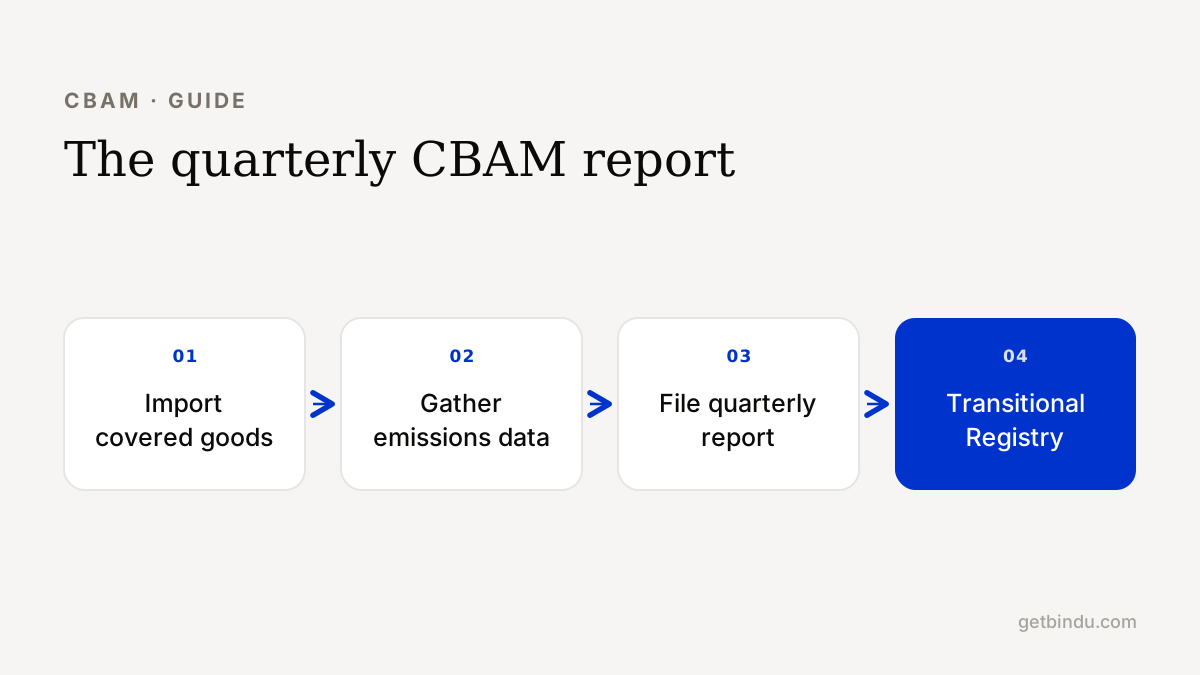
For that quarter, the trader does four things. First, record the quantity and the CN code. Second, ask the mill for the embedded emissions per tonne. Third, note any carbon price the mill already paid at home. Fourth, file the line in the CBAM Transitional Registry before the deadline.
If the mill sends nothing, the trader falls back to default values. Those usually read higher than the real number. The trader can still file, but the figure is weaker, and it is harder to defend once the charge begins.
What changed in 2026?
The quarterly report was a transitional tool. It ended with the transitional period.
From 1 January 2026 the definitive regime applies. The definitive regime is the permanent phase of CBAM. Quarterly reports give way to a single annual CBAM declaration, and the charge begins. Importers buy and surrender CBAM certificates to cover their emissions.
There is also a gate on who can import. In the definitive regime the importer must hold authorised CBAM declarant status. The certificates then cover the emissions those goods carry. The reporting habit built in the transitional years is what feeds that annual declaration.
The table below sets the two phases side by side.
| Item | Transitional period (Oct 2023 to Dec 2025) | Definitive regime (from Jan 2026) |
|---|---|---|
| Filing | Quarterly report | Annual CBAM declaration |
| Payment | None | Buy and surrender CBAM certificates |
| Who files | Reporting declarant | Authorised CBAM declarant |
| First filing | Report for the last quarter of 2023 | Annual declaration due 30 September 2027 for 2026 goods |
So if you are reading this in 2026, the quarterly report is behind you. What matters now is the annual declaration. It is first due 30 September 2027 for goods imported in 2026.
Where Bindu fits. With the quarterly return gone, the work is holding a whole year of consignments together until the annual declaration falls due. Bindu keeps each covered import, its supplier, its emissions evidence and its date on one record, and keeps them together for that declaration. See the CBAM breakdown.
FAQ
What is a CBAM report? A CBAM report is a quarterly return on the embedded emissions of goods imported into the EU during the CBAM transitional period (1 October 2023 to 31 December 2025). It carried no payment; it was a data-gathering step before the charge began.
Source: EUR-Lex: Implementing Regulation (EU) 2023/1773 (CBAM transitional reporting)
Do I still file quarterly CBAM reports in 2026? No. The transitional period ended on 31 December 2025 and the last quarterly report was due 31 January 2026. From 1 January 2026 the definitive regime applies, and quarterly reports are replaced by a single annual CBAM declaration.
Source: EUR-Lex: CBAM, Regulation (EU) 2023/956
Who has to file for CBAM? The reporting declarant: usually the importer of the covered goods, or an indirect customs representative acting on their behalf. In the definitive regime the importer must be an authorised CBAM declarant.
Source: European Commission: Carbon Border Adjustment Mechanism
Which goods are covered by CBAM? The goods listed in Annex I of the CBAM regulation: iron and steel, aluminium, cement, fertilisers, electricity, and hydrogen, along with certain downstream products. Goods originating in Iceland, Liechtenstein, Norway and Switzerland are excluded.
Source: EUR-Lex: CBAM, Regulation (EU) 2023/956
What went in a CBAM report? For each consignment: the quantity and CN code of the goods, the embedded direct and, where relevant, indirect emissions per tonne, any carbon price already paid in the country of production, and details of the installation and calculation method used.
Source: EUR-Lex: Implementing Regulation (EU) 2023/1773 (CBAM transitional reporting)