
CBAM Certificates: How the EU Carbon Charge Is Paid

For two years CBAM cost nothing. You filed a quarterly report, and that was it.
That changed on 1 January 2026. The reports still matter, but now there is a bill, and the bill is paid in a thing called a CBAM certificate.
A certificate is how the EU puts the same carbon price on an imported tonne of steel as on one made inside the EU.
At a glance:
- A CBAM certificate covers one tonne of embedded CO2 in imported goods.
- The price tracks the EU ETS auction price. There is no fixed rate.
- Certificates first go on sale on 1 February 2027.
- The first annual declaration and surrender fall due on 30 September 2027, covering 2026 imports.
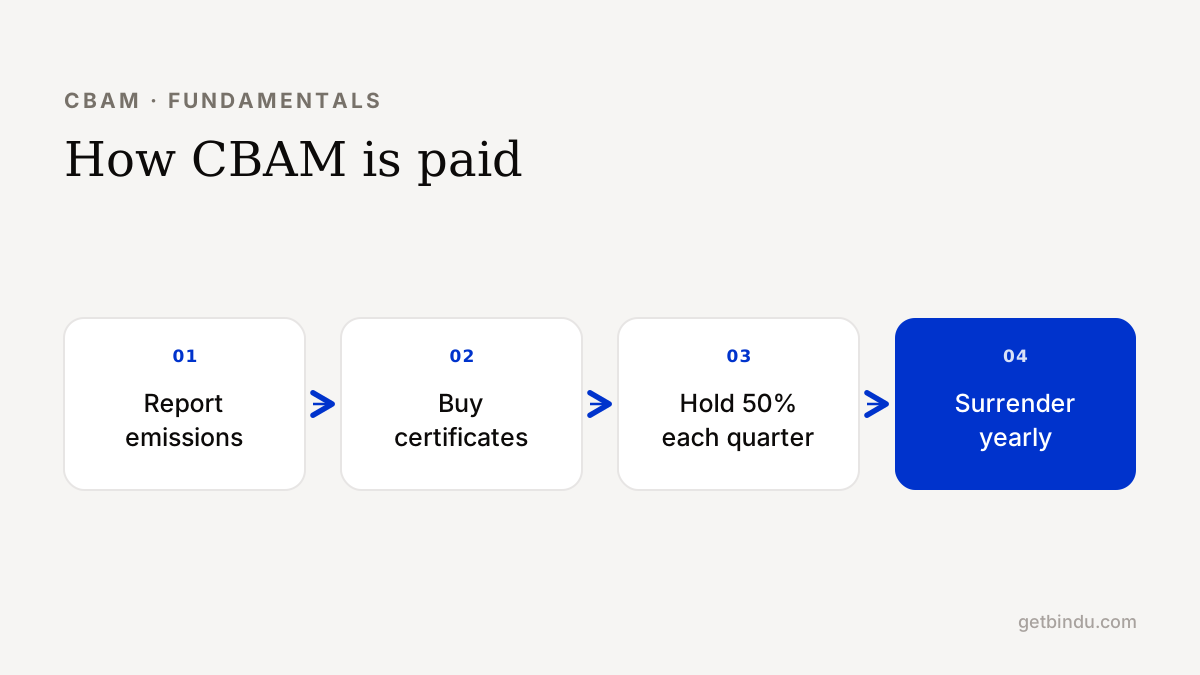
- You must hold certificates equal to at least 50% of your running emissions at the end of each quarter.
- Importers below 50 tonnes of covered goods a year are out of scope, except for electricity and hydrogen.
What is a CBAM certificate?
A CBAM certificate is the payment side of the Carbon Border Adjustment Mechanism. One certificate covers one tonne of embedded CO2 in the goods you import. The mechanism was created by Regulation (EU) 2023/956.
Embedded emissions are the CO2 released in making the goods, before they ever reach the EU border. That figure is what a certificate is priced against.
The idea is to level the field. EU producers already pay for their carbon under the EU Emissions Trading System (ETS). A CBAM certificate makes an importer pay the same price on the carbon embedded in covered goods from outside the EU.
So there is no fixed rate on it. The price tracks the carbon market.
What does a certificate cost?
There is no set price. One certificate equals one tonne of CO2, and its price follows the EU ETS auction price.
The Commission works out the price from average ETS auction results and publishes it, so it moves with the market. You buy enough certificates to match your verified embedded emissions, or to match the default values that stand in when a supplier sends nothing.
If a carbon price was already paid where the goods were made, that amount is deducted, so the same tonne is never charged twice. The deduction lowers your CBAM bill, but it does not remove the reporting behind it. You still need proof of what was paid.
The dates that matter now
The definitive regime is the paid phase of CBAM. It began on 1 January 2026. From that date, only an authorised CBAM declarant may import covered goods.
An authorised CBAM declarant is the party the customs and CBAM rules allow to bring covered goods into the EU. Without that status, the import does not clear.
The money mechanics run a year behind the imports. The table below sets out the sequence.
| Date | What it triggers |
|---|---|
| 1 January 2026 | Definitive regime starts. Only an authorised CBAM declarant may import covered goods. |
| End of each quarter, from 2026 | Hold certificates equal to at least 50% of your running embedded-emissions total. |
| 1 February 2027 | CBAM certificates first go on sale on the common central platform. |
| 30 September 2027 | First annual CBAM declaration due, for goods imported in 2026, with certificates surrendered to match. |
| Every following 30 September | The annual declaration and surrender fall due again. |
| 2034 | Free ETS allowances for CBAM sectors are fully gone. Importers pay for 100% of embedded emissions. |
There is also a holding rule that runs through the year. You must hold certificates equal to at least 50% of your running emissions total at the end of each quarter. It is a rolling obligation, topped up quarter by quarter, then trued up once at year end.
A worked example
Round numbers make the mechanics clearer. For example, consider a year of covered imports whose verified embedded emissions add up to 500 tonnes of CO2. You need 500 CBAM certificates, one for each tonne.
The holding rule shapes the timing. If your running total reaches 200 tonnes by the end of the first quarter, you must already hold at least 100 certificates, half of the total so far. You keep topping up each quarter as more imports land.
At year end you true up. You surrender the full 500 certificates against the annual declaration. If a carbon price was already paid in the country of production, the amount you paid there is deducted, so the same carbon is not charged twice.
So the surrender is one big number in September, but the cash goes out earlier, in quarterly slices, from the moment the goods arrive.
Why the charge grows over time
Today, EU producers still get some free ETS allowances, which softens the CBAM price. That cushion is being removed.
The free allowances for CBAM sectors phase out and are fully gone by 2034. At that point importers pay for 100% of embedded emissions. So the CBAM bill on the same shipment rises every year between now and then.
Two things push the same shipment up over time. The free-allowance cushion shrinks, and the ETS price itself can move. Neither is under an importer's control, which is why the emissions figure you can defend matters more each year.
Who is now out of scope
The 2025 simplification gave smaller importers relief. Under Regulation (EU) 2025/2083, in force since 20 October 2025, an importer below 50 tonnes of covered goods a year falls out of scope for those goods.
This de minimis does not reach electricity or hydrogen, which stay in scope from the first import, whatever the tonnage. So a small importer of covered goods such as steel may be relieved, while the same importer of electricity is not.
Where Bindu fits. The 50% holding rule means you need your running exposure every quarter, well ahead of the September surrender. Bindu tracks the emissions evidence per import as it arrives, so the quarterly position and the September number come off the same figures. See the CBAM breakdown.
FAQ
What is a CBAM certificate? A CBAM certificate represents one tonne of embedded CO2 in imported goods. Importers of covered goods buy certificates and surrender them each year to pay the same carbon price EU producers pay under the EU Emissions Trading System.
Source: EUR-Lex: CBAM, Regulation (EU) 2023/956
How much does a CBAM certificate cost? There is no fixed price. One certificate covers one tonne of CO2, priced off average EU ETS auction prices, which the Commission calculates and publishes. Any carbon price already paid in the country of production is deducted.
Source: European Commission: Carbon Border Adjustment Mechanism
When can I buy CBAM certificates? Certificates first go on sale on 1 February 2027. The first annual CBAM declaration and surrender fall due on 30 September 2027, covering goods imported in 2026, and each following year on 30 September.
Source: EUR-Lex: CBAM, Regulation (EU) 2023/956
Do I have to hold certificates during the year? Yes. You must hold certificates equal to at least 50% of your running embedded-emissions total at the end of each quarter, then surrender the balance once a year.
Source: EUR-Lex: CBAM, Regulation (EU) 2023/956
Is any importer exempt from CBAM certificates? Yes. Since 20 October 2025, an importer below 50 tonnes of covered goods a year is out of scope for those goods, under the CBAM simplification. The exemption does not apply to electricity or hydrogen.
Source: EUR-Lex: Regulation (EU) 2025/2083 (CBAM simplification)