
Recycled Polyester: Why the Claim Is Hard to Verify

A buyer asks you to sign off a recycled polyester claim on a jacket. You have a transaction certificate and a supplier declaration. And a figure typed on a tech pack. What you do not have is a test.
Nothing in the garment shows that its fibre came from recovered material. A lab can read what the fibre is. It cannot read where it came from. No such test method has been agreed.
The paperwork can be in order. The material can still fail at the recycler.
At a glance:
- Recycled polyester is a claim about where the feedstock came from, not a property you can measure in the finished fibre.
- Textile research centres list a missing test for recycled content among the open standards gaps, as of late 2024.
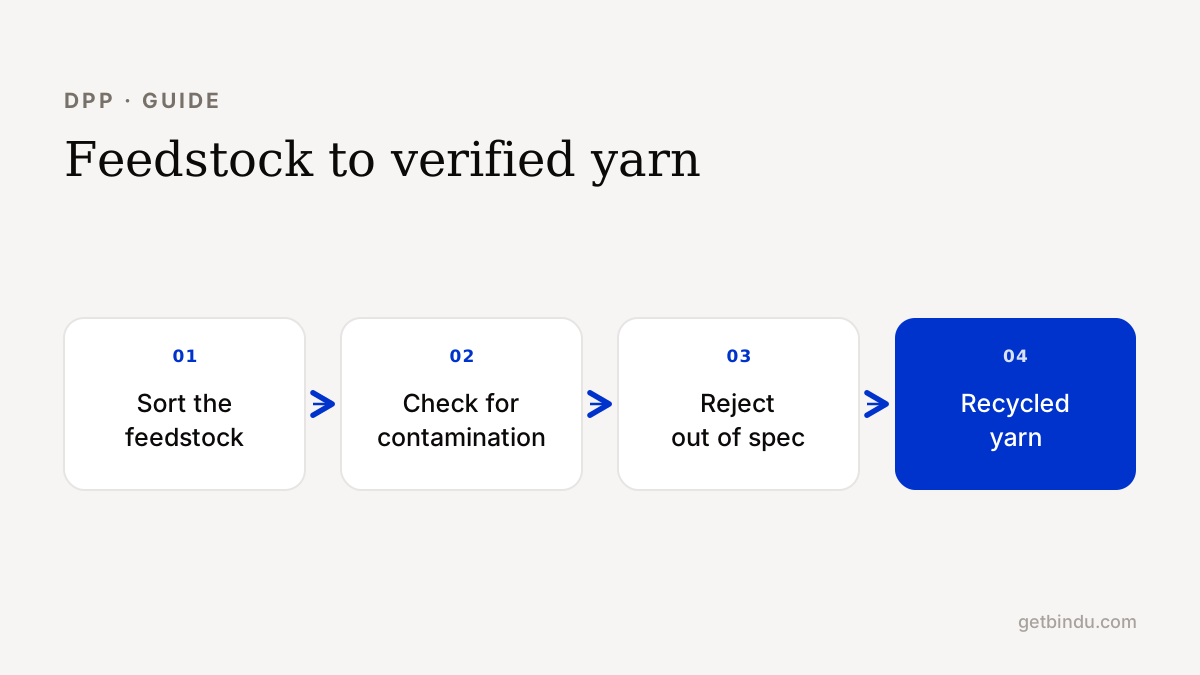
- In the T-REX pilot, the recycler rejected both polyester output batches as out of spec.
- A third batch gave 125 kg of yarn from 300 kg of input. The other 175 kg was logged as working loss.
- One planned recycling route takes 90 to 100 percent PET by garment weight and no more than 5 percent cotton.
What recycled polyester actually is
Recycled polyester is polyester made from used PET. The CISUTAC circular business models report put recycled polyester at 15 percent of global fibre production in 2021. Almost all of that was bottle based. Newer routes use discarded textiles instead. Recycled content is the share of a product's mass that came from recovered feedstock, not fossil inputs.
Recovered PET and virgin PET are the same polymer. A recycled fibre carries no marker a lab can read off. There is no dye to look for and no tag in the yarn. So the claim rests on chain of custody paperwork.
CITEVE is working on methods to tell recycled PES (polyester) fibres from virgin PES. That work sits under the Portuguese be@t project. The techniques include DSC, oscillatory plate rheology, MFI, FTIR, TGA, GPC, methanolysis and swelling of PET. None of it is yet a standard you can cite.
The standards gap, in the research centres' own words
A 2024 report published through ECOSYSTEX lists the gaps. It comes from Technical Group 4. Its lead authors sit at Centexbel and Citeve, two textile research centres. Neither CEN nor ISO wrote it. So it is a read on the field, not a rule book. The gaps arrive as examples, in no order. One matters for every recycled polyester claim: "Determination of recycled content, both for synthetic and natural fibres (by testing, to verify claims)". That is the test no one has. The report warns that its own list "will become outdated with time". Read it as the position in late 2024. It may have moved since, so check before you lean on it.
prEN 17903 sat under CEN/TC 134/WG 8, the floor coverings group, not apparel. It would have defined and declared recycled content in textile floor coverings. It failed the formal vote. The work then stopped. It was never the test the gap list asks for. The report records what came next: "A work item applicable to all floor coverings will be started". Read that as a rescoping, not a dead end.
The committee that owns textile circularity is CEN/TC 248/WG 39. In late 2024 it had one published standard. That was EN ISO 5157:2023, a vocabulary. Six more work items were running. One has now landed. CEN/TS 18272-1, "Textiles - Circular economy for textile products - Part 1: General principles and guidance", was published on 26 August 2026. It sets terminology and principles, not a way to check a recycled content figure. So it helps you name things, not check them.
Plastics packaging is further ahead. Its design for recycling series was published as EN 18120:2026 in 15 parts. It also has quality grades for sorted PET, PVC and PS waste. Textiles have nothing that close for polyester feedstock.
Is polyester recyclable?
Polyester is recyclable as a polymer. As a garment it often is not. The garment brings other things with it: elastane, cotton, coatings, heat transfers, zips and labels. Each of those has to come out first. Some of them cannot.
A showstopper material is defined in the T-REX data model work as "a material that renders an entire batch of textile waste unusable for recycling when present". The field was then cut from the model. The reason given: "sorting facilities currently lack the technical and economic means to provide this level of accuracy". The hazardous materials field went for the same reason. So the model names the risk, then stops asking about it.
On the T-REX polyester route some materials rule a garment out. PAN (acrylic) and PLA are on that list. So are animal fibres such as wool, silk and down. The list also covers ABS, POM, natural and synthetic rubber, TPE, TPR and acrylic polymer.
What a recycler can actually accept
The T-REX Technical Guidance for Recyclable Garments sets limits. They come from three named recyclers' tested capabilities. For polyester the route is CuRe Technology. The numbers are "the projected capabilities of CuRe Technology's commercial scale facility, which is in the planning phase". A planned plant, not a running one. The guidance adds that the tables "may change over time". So read the caps as a target, not a promise.
Limits are shares of garment weight.
| Material | Allowed share of garment weight |
|---|---|
| PET | 90 to 100 percent |
| PBT | 0 to 10 percent |
| PTT | 0 to 10 percent |
| PEF | 0 to 5 percent |
| Elastane | 0 to 5 percent |
| Cotton | 0 to 5 percent |
| Polyamide | 0 to 5 percent |
| PE | 0 to 10 percent |
| PP | 0 to 10 percent |
| PU | 0 to 5 percent |
| TPU | 0 to 5 percent |
| Silicone | 0 to 10 percent |
| Other cellulosics | 0 to 5 percent |
| Man made cellulosics | 0 to 5 percent |
| Ferrous and non ferrous metal | 0 to 10 percent |
| Glass particles | 0 to 5 percent |
Take the guidance's own worked example. A football jersey has a 96.8 percent PET body. A backneck tape adds 1.0 percent PET. The label and the thread are PET too. Logo heat transfers add 0.1 percent PU and 0.1 percent TPU. The garment totals 99.8 percent PET, 0.1 percent PU and 0.1 percent TPU. There are no hard trims. It passes.
What happened when a pilot ran it
The T-REX project followed real batches. It wrote them up in its WP7 report, "Piloting a data model for textile-to-textile recycling" (May 2025). Every number below carries the report's own caveat. The data "are only indicative of the T-REX project and cannot be taken as representative of the operations of the entities".
The polyester stream started well on paper. Sorted feedstock was declared at 98 percent polyester. The grade name was ">98% POST MULTI (ND)(F)". Sensor accuracy was given as 99 percent in the pilot's own figures. Read on paper, that is a clean stream. Then 2,100 kg went to pre-processing at Nouvelles Fibres Textiles. That step gave two output batches of roughly 900 kg each.
Both were rejected at the recycler as "Waste, Out of spec". The first reason: "Not recyclable: the compacted material disintegrated and could not be processed". The second: "Not recyclable: lab tests showed too much cotton contamination".
A separate batch from CIRCULR did run. The input was 300 kg. Out came 125 kg of yarn. The other 175 kg was logged as working loss. That is roughly 42 percent yield. The recorded note reads: "Lower than expected: the heat transfers & logos resulted in shorter standtime of filters than expected".
Working loss is this post's plain word for input mass that never leaves a process step as usable output. The report records no agreed definition. Recyclers "required clarity on how to define these terms". The report recommends standardising "Out of Spec" and "Working Loss" at a recycling level. So the same loss can be booked two ways at two plants.
Why the paperwork never flagged it
Across all three pilot streams the Impurity Name field read "Unknown". The field was there and no one filled it in. Sorters "were unable to provide details on feedstock contamination in the sorted batch. Some NIR scanning technology can detect this on a garment level, but this information is not recorded at a bale level".
The composition figure itself is thinner than it looks. "Sorters use NIR scanner settings to define the Composition Value. They are unable to provide a more accurate measurement of fibre composition, however they noted that feedstock requirements were typically met under such settings". So a declared figure can be a scanner setting, not a lab result. The intake spec looks satisfied all the same. And the batch moves on.
The guidance is blunt about what near infrared scanning misses. The first gap is the blend itself. "Blended materials decrease accuracy of NIR scanning". Then there is what sits on top of the cloth. "Finishes and coatings cannot be detected by NIR". A scan is also a set of points, not a sweep. Garment parts with a different composition "can go unnoticed as NIR only scans specific points". A panel or a lining can hide that way. Depth is the last gap. Multilayer garments are hard because "NIR only scans the garment surface".
What to hold in the claim file
These reports are research papers. They show what plants can do today. Treat them as evidence about practice, never as law.
The legal frame is ESPR, Regulation (EU) 2024/1781. Product rules arrive through delegated acts. The working plan adopted on 16 April 2025 makes textiles a priority. The Commission's textile apparel page gives Q4 2027 as the planned adoption date for the textile act. Whether that act carries a recycled content rule is not settled. The field list is not fixed. Our walkthrough of what ESPR actually does covers that frame.
Four records do the work:
- A lot level transaction certificate that names the invoice and the batch. Not a site scope certificate. The textile evidence documents guide explains the difference.
- A bill of materials at component level, with weights. That is what lets you test a garment against a threshold table. For example, a garment at 6 percent elastane by weight is already over the CuRe cap.
- Every trim, coating, heat transfer and print declared. NIR cannot see them. Filters do.
- A note on each composition figure: a test, or a scanner setting.
Our piece on textile passport data requirements sets out the fields a brand must own.
Where Bindu fits. Bindu reads supplier certificates, invoices and lab reports into product records. The lot reference and the source document stay attached to every material figure. A recycled polyester claim then becomes a file you can defend line by line. See the textile passport breakdown.
FAQ
Is polyester recyclable? As a polymer, yes. As a garment, often not on a given route. T-REX guidance lists showstoppers for the polyester route. They include acrylic, PLA, wool, silk, down and rubber. It caps elastane and cotton at 5 percent of garment weight each.
Source: T-REX Technical Guidance for Recyclable Garments
Is there a test that verifies recycled content in polyester? Not an agreed one. The 2024 ECOSYSTEX standards report lists a test for recycled content among its open gaps. CITEVE is developing methods to tell recycled PES from virgin PES. That work is not yet a standard.
Source: ECOSYSTEX standards overview and gap analysis
Why would a batch declared 98 percent polyester be rejected? Because the declared figure often comes from a scanner setting. It is not a lab result. Impurities are also not logged at bale level. Two pre-processed T-REX batches were rejected. One failed after lab tests showed too much cotton.
Source: T-REX WP7 report on piloting a data model
Does EU law require recycled content in textiles yet? No. ESPR, Regulation (EU) 2024/1781, is the frame. Product rules arrive through delegated acts. The Commission gives Q4 2027 as the planned adoption date for the textile act. So no recycled content rule applies to clothing under it today.
Source: Regulation (EU) 2024/1781
What yield should we expect from textile to textile polyester recycling? There is no reliable published figure. One T-REX pilot batch gave 125 kg of yarn from 300 kg of input. The project states its data are only indicative of the project.