
REACH Annex XVII Entry 72: CMR Substances in Clothing

A buyer sends the spec for a padded winter jacket. Polyester shell, cotton lining, a metal zip.
One rule decides whether it can be sold to EU consumers. It is entry 72 of REACH Annex XVII.
Entry 72 puts hard caps on a short list of harmful substances. They apply to clothing, textiles and footwear, and they have applied since 1 November 2020.
Most teams meet the rule late. A lab report lands on a style that is already in production.
At a glance:
- Entry 72 caps 33 CMR substances in consumer clothing, footwear and textiles that touch skin.
- The numbers sit in Appendix 12. Each one is measured in the material, not in the whole garment.
- Scope covers clothing, related accessories, footwear, and other textiles that touch skin like clothing.
- Leather-only parts, non-textile fasteners, second-hand goods, carpets, safety gear and medical devices are out.
- The rule applied from 1 November 2020. Formaldehyde dropped to its full limit on 1 November 2023.
What entry 72 restricts
Entry 72 is the REACH Annex XVII restriction on CMR substances in consumer clothing, footwear and skin contact textiles.
CMR means carcinogenic, mutagenic or toxic for reproduction, in category 1A or 1B. The EU treats those hazard classes most gravely.
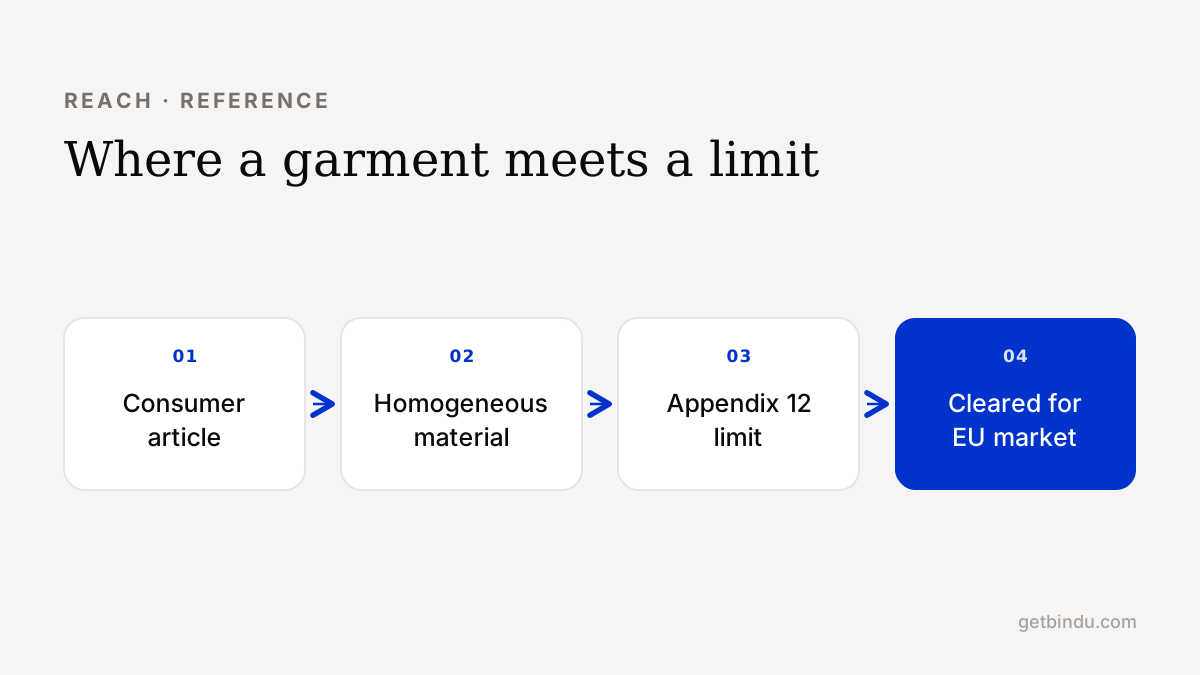
The rule itself is one sentence. You may not sell the product in the EU if a listed substance sits at or above its limit.
Two phrases carry the weight. The product must be for use by consumers. The level is measured in homogeneous material.
A homogeneous material is one material you cannot pull apart by hand or with simple tools. So a jacket is never tested as a jacket. The shell, the lining and the thread are each their own test.
That has a sharp edge. One bad lining fails the whole garment, even when every other part is clean.
The substances get there in two ways. Some arrive as impurities from the production process. Others are added on purpose, to give the material a property the buyer asked for.
Which products are in scope
The restriction names three categories.
- Clothing and related accessories. The Commission names sportswear and bags as examples.
- Textiles other than clothing that touch skin the way clothing does, such as bedlinen, blankets, upholstery and cloth nappies.
- Footwear.
The second group is the one people misjudge. It is not every textile. The test is skin contact, and the yardstick is clothing.
The consumer wording is wider than it looks. Use inside a public service counts too. For example, bedlinen in a hospital or seat covers in a library.
How Appendix 12 is built
Appendix 12 is the table that holds the numbers. Entry 72 names no substance itself. It points at column 1 of that table.
The table runs five columns: Substances, Index-No, CAS No, EC No, and the limit by weight. It holds 33 rows.
Those rows are not a flat list. They fall into groups. Each group shares one limit.
| Substance group in Appendix 12 | Limit by weight |
|---|---|
| Cadmium, chromium VI, arsenic and lead compounds | 1 mg/kg after extraction |
| Eight PAH compounds, such as benzo[a]pyrene | 1 mg/kg |
| Three chlorinated toluenes | 1 mg/kg |
| Benzene | 5 mg/kg |
| Four aromatic amine salts | 30 mg/kg |
| Three dyes, such as C.I. Disperse Blue 1 | 50 mg/kg |
| Quinoline | 50 mg/kg |
| Formaldehyde | 75 mg/kg |
| Five phthalates, such as di-n-hexyl phthalate | 1,000 mg/kg, alone or combined |
| Three solvents used in coating and finishing | 3,000 mg/kg |
Two things to note. The four metals are measured after extraction, not as total content. So the test method is part of the limit. The phthalate cap also stacks. It counts those five along with other CMR phthalates held elsewhere in Annex XVII.
Formaldehyde had a grace period, and the reason is worth knowing. It is used in jackets and coats to hold their shape, and in upholstery as a flame retardant. Alternatives were thin on the ground, so jackets, coats and upholstery were allowed 300 mg/kg from 1 November 2020 to 1 November 2023. The full limit of 75 mg/kg has applied since. The whole table sits in Regulation (EU) 2018/1513, the law that added entry 72.
What entry 72 leaves out
The exemptions carry as much weight as the limits. There are five of them.
- Clothing, accessories, footwear, or parts of them, made only of natural leather, fur or hide.
- Non-textile fasteners and non-textile decorative attachments.
- Second-hand clothing, accessories, textiles and footwear.
- Wall-to-wall carpets, indoor textile floor coverings, rugs and runners.
- Goods covered by the EU rules on safety gear or on medical devices.
Disposable textiles are out of the skin contact group as well. The law defines them as textiles made for one use, or for limited use. They are not meant to serve the same purpose again.
The leather exemption is tighter than most people read it. It covers parts made only of leather, fur or hide. A leather boot with a cloth lining is still in scope on that lining.
The carpet exemption is flagged as short term. The Commission has to review it, and change it if that turns out to be right.
One more line matters. Entry 72 applies without prejudice to stricter rules elsewhere. Passing it does not clear entry 43 on azo dyes or entry 47 on chromium VI.
A worked example: the padded jacket
Go back to the jacket. It is a consumer garment, so entry 72 applies.
Break it into single materials: shell, lining, wadding, thread, printed label, metal zip, plastic toggle.
The zip and the toggle drop out. Non-textile fasteners and trims are exempt. Everything else stays in.
Now read the table against each part. Shell and lining carry dye, so the dye and amine rows are live. Wadding and coatings can hold solvent traces. That puts the 3,000 mg/kg row in play. The shell is a coat, so formaldehyde sits at 75 mg/kg. No grace period is left to lean on.
What you end up holding is not one certificate. It is a result for each material, read against the entry 72 limits. You keep it for as long as the style is on sale.
Where entry 72 sits in REACH
Entry 72 is one line of the restricted substances list. That hub explains how any Annex XVII entry is built. It also shows which entries importers meet most often.
It is also the bridge between chemicals work and textiles work. REACH compliance runs on knowing what is inside your goods. The Candidate List makes you disclose substances of very high concern. Entry 72 instead sets a number you may not cross.
And it points forward. The digital product passport for textiles will ask for substance data material by material. Entry 72 already tests at that level. A team that can answer it today has most of that work done.
Where Bindu fits. Entry 72 asks about each material in a garment, not about the garment. The proof also has to survive a check years later. Bindu holds the bill of materials, the limit for each part, and the report behind it, dated in one record. See the REACH breakdown.
FAQ
What is REACH Annex XVII entry 72? Entry 72 is the REACH rule on CMR substances in consumer clothing, related accessories and footwear. It also covers other textiles that touch skin the way clothing does. It has applied since 1 November 2020.
Source: ECHA: Substances restricted under REACH (Annex XVII)
Which substances does entry 72 cover? Entry 72 covers the 33 substances listed in Appendix 12, grouped by limit. The groups take in four metals, benzene, formaldehyde, some phthalates, some dyes and some solvents.
Source: EUR-Lex: Regulation (EU) 2018/1513
How are the entry 72 limits measured? The limits apply by weight in homogeneous material. So each material you can separate is checked on its own. The metals in the table are measured after extraction, not as total content.
Source: EUR-Lex: Regulation (EU) 2018/1513
What is exempt from entry 72? Parts made only of natural leather, fur or hide are exempt. So are non-textile fasteners and trims, second-hand goods, carpets and indoor floor coverings. Disposable textiles and goods under the EU rules for safety gear or medical devices are out too.
Source: EUR-Lex: Regulation (EU) 2018/1513
Does entry 72 apply to footwear? Yes. Footwear for use by consumers is one of the three groups in scope. Parts made only of natural leather, fur or hide are exempt. So a leather shoe with a cloth lining is still checked on that lining.