
REACH Annex XVII List: Restricted Substances and Limits

Customs holds a container of children's textiles. The note gives one reason: azo dyes. The importer has a test report, but it covers the wrong dye.
That reason is a line in REACH Annex XVII. Below is the list itself: the substance, the products each entry covers, and the number that decides whether a shipment moves.
At a glance:
- Annex XVII is the restriction list of REACH. Each entry is a limit or a ban you cannot exceed.
- The table below carries the twelve entries that come up most in consumer goods checks, with the exact limit for each.
- An entry ties a substance to a use, so one chemical can be legal in one product and banned in another.
- The list runs to entry 83 and grows as the EU adopts new restrictions.
- Entry 77 on formaldehyde has applied since 6 August 2026. Entry 79 on PFHxA starts on 10 October 2026.
The Annex XVII restricted substances list
Every limit below is taken from the official ECHA conditions of restriction for that entry. Each entry number links to its detail further down this page.
| Entry | Substance | Where it bites | The limit | Source |
|---|---|---|---|---|
| 20 | Organostannic (tin) compounds | Antifouling paint, treated articles, water treatment | Tributyltin and triphenyltin: not in articles above 0.1% by weight of tin | Conditions |
| 23 | Cadmium and its compounds | Listed plastics, paints, brazing fillers, jewellery | 0.01% by weight as cadmium metal in the plastic, paint, filler or jewellery part | Conditions |
| 27 | Nickel | Piercing posts, jewellery, watch straps, zips and buttons | Release under 0.2 µg/cm²/week in piercing posts, and 0.5 µg/cm²/week in prolonged skin contact | Conditions |
| 43 | Azocolourants and azodyes | Textile and leather articles touching skin or the mouth | Listed aromatic amines not detectable above 30 mg/kg (0.003%) | Conditions |
| 46a | Nonylphenol ethoxylates (NPE) | Textile articles expected to be washed in water | Under 0.01% by weight of the article or of each part, since 3 February 2021 | Conditions |
| 47 | Chromium VI compounds | Cement, leather that touches the skin | 2 mg/kg soluble chromium VI in hydrated cement, 3 mg/kg (0.0003%) in leather | Conditions |
| 50 | Polycyclic aromatic hydrocarbons (PAH) | Rubber and plastic parts in skin or mouth contact, tyre oils | 1 mg/kg of any listed PAH in consumer articles, 0.5 mg/kg in toys | Conditions |
| 51 | Phthalates DEHP, DBP, BBP and DIBP | Toys and childcare articles, plasticised parts of other articles | 0.1% by weight of the plasticised material, singly or combined | Conditions |
| 63 | Lead and its compounds | Jewellery, imitation jewellery, hair accessories | 0.05% by weight of lead in any individual part | Conditions |
| 72 | The substances listed in Appendix 12 | Consumer clothing, accessories, skin-contact textiles, footwear | Each substance under its own Appendix 12 limit, since 1 November 2020 | Conditions |
| 77 | Formaldehyde and formaldehyde releasers | Articles placed on the market from 6 August 2026 | Release at or under 0.062 mg/m³ for furniture and wood, 0.080 mg/m³ otherwise | Conditions |
| 79 | PFHxA, its salts and related substances | Consumer clothing and footwear, food-contact paper, cosmetics | From 10 October 2026: 25 ppb for PFHxA and salts, 1,000 ppb for related substances | Conditions |
Two cautions before you rely on a row. First, an entry can carry exemptions, derogations and transition dates, so read its full text rather than a one-line summary. Second, the scope wording controls. "Skin contact", "childcare article" and "placed on the market" each has a precise meaning that decides whether your part is in or out.
For the entries not in this table, work from the ECHA restriction list, which carries all of them with their current conditions.
How a restriction is built
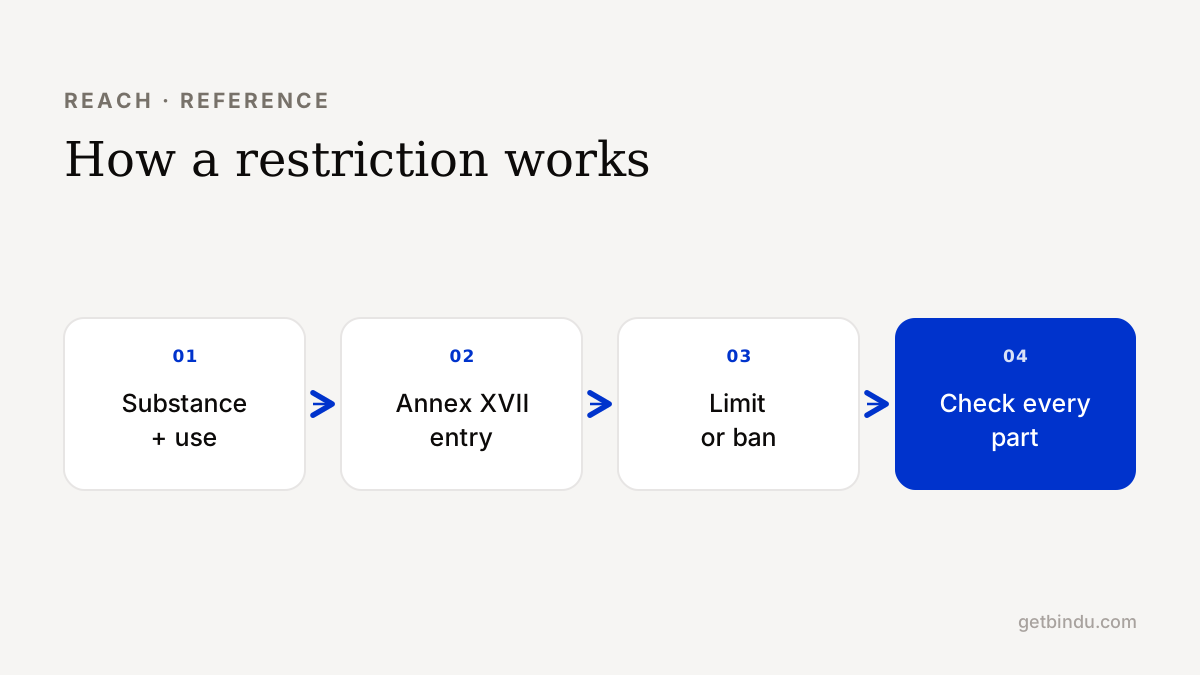
An Annex XVII entry is a substance tied to a specific use and a specific limit.
Read any entry and you find three parts: the substance or group of them, the condition of use, and the limit. The limit can be a concentration cap, a release rate, a specific ban, or a labelling duty.
So the same substance can be fine in one product and banned in another. A blanket "is it restricted?" has no answer until you name the product and the part.
A restriction can bite at three levels: the substance alone, in a mixture, and in a finished article. A dye in a drum and the same dye fixed in a shirt are both in scope. What changes is the proof, supplier data for the raw chemical or a test on the finished part.
Each entry in detail
Entry 20: organostannic compounds
Tin compounds are barred as biocides in antifouling paint and in industrial water treatment. Tributyltin and triphenyltin may not be used in articles above 0.1% by weight of tin. Non-compliant articles could not be placed on the market after 1 July 2010.
Entry 23: cadmium
Cadmium is capped at 0.01% by weight, measured as cadmium metal. That cap covers a named list of plastics, paints under tariff codes 3208 and 3209, brazing fillers, and metal jewellery parts. Paints with more than 10% zinc get 0.1% instead, and a painted article fails at 0.1% of the paint on it (conditions of restriction).
Entry 27: nickel
Nickel is controlled by release rate, not by content. Piercing post assemblies must release under 0.2 µg/cm²/week. Articles in direct prolonged skin contact must not exceed 0.5 µg/cm²/week, such as earrings, watch straps, zips and rivet buttons in garments.
Entry 43: azocolourants and azodyes
Some azodyes break down into the aromatic amines listed in Appendix 8. Those dyes are barred from textile and leather articles that touch skin or the mouth, such as clothing, bedding, towels, footwear and textile toys. The trigger is a detectable concentration above 30 mg/kg, which is 0.003% by weight, in the article or in its dyed parts.
Entry 46a: nonylphenol ethoxylates
NPE is capped at 0.01% by weight in textile articles that can reasonably be expected to be washed in water. That has applied since 3 February 2021. Second-hand textiles are out of scope, as are new articles made only from recycled textiles without NPE.
Entry 47: chromium VI
Cement fails above 2 mg/kg soluble chromium VI of total dry weight when hydrated. Leather that touches the skin fails at 3 mg/kg, which is 0.0003% of dry weight, and the same limit applies to each leather part of a larger article.
Entry 50: polycyclic aromatic hydrocarbons
A consumer article fails if any rubber or plastic part in prolonged or repeated skin or mouth contact holds more than 1 mg/kg of any listed PAH. Toys and childcare articles get a tighter 0.5 mg/kg. Tyre extender oils are capped at 1 mg/kg benzo[a]pyrene and 10 mg/kg for the sum of the listed PAHs.
Entry 51: phthalates
DEHP, DBP, BBP and DIBP are capped at 0.1% by weight of the plasticised material, singly or combined, in toys and childcare articles. Since 7 July 2020 that cap also reaches plasticised material in articles generally, with carve-outs including outdoor use away from mucous membranes.
Entry 63: lead
Lead is capped at 0.05% by weight in any individual part of a jewellery article. The entry reads jewellery widely, such as rings, piercing jewellery, watches and wrist-wear, brooches, cufflinks and hair accessories.
Entry 72: substances in clothing and footwear
Entry 72 works off a list, and it has a walkthrough of its own. The substances in Appendix 12 may not reach their stated concentration in consumer clothing, accessories, footwear, or other textiles that touch skin the way clothing does. Articles made only of natural leather, fur or hide are out, as are non-textile fasteners and second-hand goods.
Entry 77: formaldehyde
From 6 August 2026 the test in Appendix 14 decides. An article fails above 0.062 mg/m³ of released formaldehyde for furniture and wood-based articles, or above 0.080 mg/m³ for everything else. Naturally occurring formaldehyde, outdoor-only articles, food-contact articles and second-hand articles are excluded, and articles under entry 72 stay there.
Entry 79: PFHxA
From 10 October 2026 PFHxA and its salts are capped at 25 ppb, and related substances at 1,000 ppb. That first wave covers consumer clothing and accessories, footwear, food-contact paper, consumer mixtures and cosmetics. From 10 October 2027 the same caps reach other consumer textiles, leather, furs and hides.
The held container, read through the list
Take the container from the top: children's cotton shirts, dyed, in direct skin contact.
Start with the product, not the chemical. A dyed textile that touches the skin puts entry 43 in scope, and consumer clothing puts entry 72 in scope too.
Now read entry 43. The question is not whether the shirt is safe in general. It is whether the dye used can release one of the Appendix 8 amines above 30 mg/kg, and whether the importer can show it does not. The report on file tested a different dye, so it proved nothing about the colourant in the cloth. That mismatch is what held the goods.
Annex XVII versus the Candidate List
These two lists get mixed up constantly, although they do different jobs.
The Candidate List is a disclosure trigger. It flags substances of very high concern, published as the Candidate List, and makes you tell your customers, answer consumers and notify SCIP. It bans nothing. Read what an SVHC is for that side.
Annex XVII sets a hard rule: a limit or a ban you cannot exceed. A substance can sit on the Candidate List, under an Annex XVII entry, or both at once. So an importer has two questions per part. What must I disclose, and what may I not place on the market at all. The wider duty set sits in REACH.
Finding your entries from the HS code
Most entries are written around product types: textiles, leather, toys, jewellery, cement. Those map onto how goods are classified for customs.
That is the useful link. The HS or CN code you already assign for the tariff is a strong signal for which entries to check on a part. Entry 23 quotes tariff codes directly in its own text. So your CN code answers a duty question and points at the restriction shortlist at the same time.
Where Bindu fits. Annex XVII work is matching the substance, the use and the entry for every part in a bill of materials. Bindu screens each part against the limits that apply, checks the Candidate List version of the day at the same time, and pins the result to a dated declaration. See the REACH breakdown.
FAQ
What is REACH Annex XVII? Annex XVII is the restriction list of REACH. It sets limits and bans on named substances in named uses, covering substances on their own, in mixtures, and in finished articles placed on the EU market.
Source: ECHA: Substances restricted under REACH (Annex XVII)
How many entries are in Annex XVII? The numbering runs to entry 83, the 2,4-dinitrotoluene restriction added by Regulation (EU) 2026/859 and applying from 10 May 2027. Each entry ties a substance, or a group of them, to a condition of use and a limit.
Source: ECHA: Substances restricted under REACH (Annex XVII)
Which Annex XVII entries affect consumer goods most? Entry 27 on nickel, entry 43 on azo dyes, entry 47 on chromium VI, entry 51 on phthalates and entry 72 on substances in clothing and footwear. Entry 77 on formaldehyde and entry 79 on PFHxA are the two that change next.
Source: EUR-Lex: Regulation (EU) 2023/1464 (formaldehyde, Annex XVII entry 77)
What is the Annex XVII limit for azo dyes? Listed azodyes must not be detectable above 30 mg/kg, which is 0.003% by weight. That applies to a textile or leather article that touches skin or the mouth, and to its dyed parts. The amines themselves are listed in Appendix 8 to the annex.
Source: ECHA: Substances restricted under REACH (Annex XVII)
When do the formaldehyde and PFHxA restrictions start? Entry 77 on formaldehyde applies to articles placed on the market from 6 August 2026. Entry 79 on PFHxA applies from 10 October 2026 for consumer clothing, footwear, food-contact paper, mixtures and cosmetics, and from 10 October 2027 for other consumer textiles.
Source: EUR-Lex: Regulation (EU) 2024/2462 (PFHxA, Annex XVII entry 79)