
EUDR Compliance for Coffee Importers: The 2026/27 Season Guide
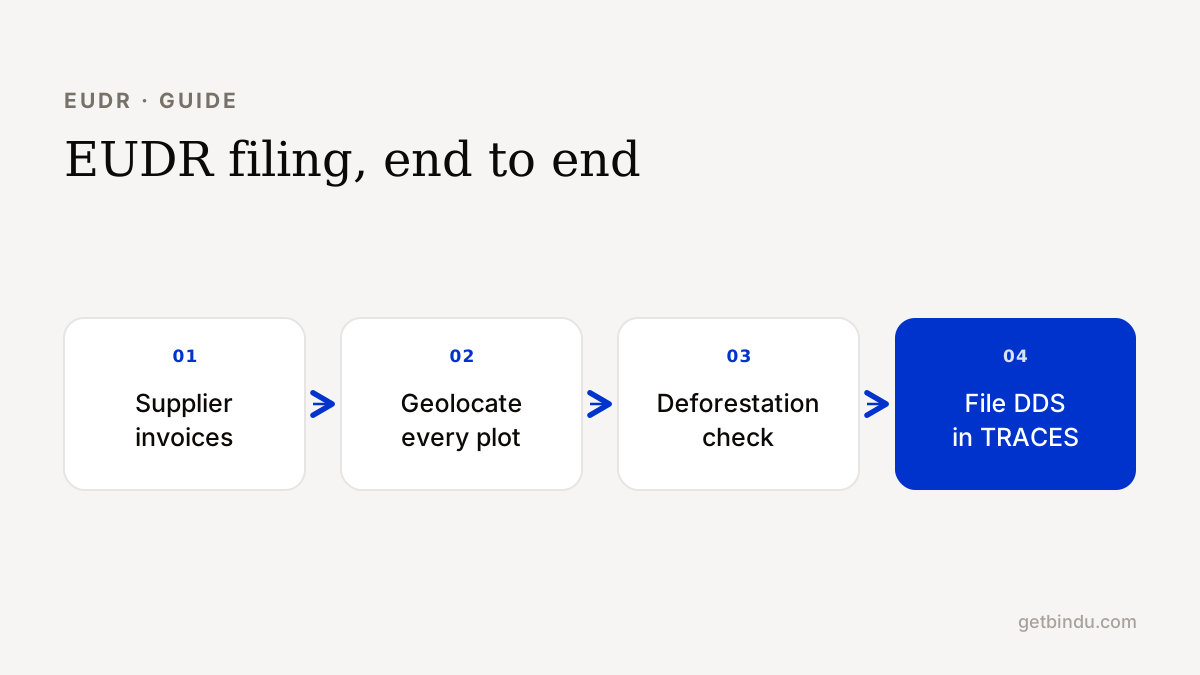
Coffee is one of seven commodities covered by the EU Deforestation Regulation. So anyone placing coffee on the EU market must file a due diligence statement (DDS) in TRACES before the goods clear customs. The DDS is backed by plot-level geolocation. That geolocation has to prove the beans were grown on land not deforested after 31 December 2020. The obligation applies from 30 December 2026 for large and medium importers, and from 30 June 2027 for micro and small operators.
At a glance:
- Coffee sits under CN heading 0901: green beans, roasted, decaffeinated, husks and skins all count.
- Every plot needs geolocation: a single point under 4 hectares, a polygon at 4 hectares or more (Article 9).
- The deforestation cutoff is 31 December 2020, and it does not reset when the land changes hands.
- Only the operator, the first party to place coffee on the EU market, files the DDS in TRACES.
- Deadlines: 30 December 2026 for large and medium operators, 30 June 2027 for micro and small.
A container of green coffee sits at the port. The paperwork looks complete. Bill of lading. Phytosanitary certificate. ICO marks on every bag. Then the customs broker sends one line by email: "Please provide the DDS reference number before we clear this". The beans came from three washing stations, sourced from hundreds of smallholders, and nobody in that chain has ever heard of a plot polygon. The season has started. So has the clock.
This is the moment EUDR compliance for coffee importers stops being a policy debate and becomes an operational problem. If you place coffee on the EU market, you are the operator the law is written for, and the DDS reference number your broker wants is not optional. The rest of this guide is how you hand your broker that number before the container stalls.
What EUDR means for coffee, specifically
The EU Deforestation Regulation, Regulation (EU) 2023/1115, entered into force on 29 June 2023. Its logic is simple and unforgiving: seven commodities may only enter the EU market if they were not grown on land deforested after 31 December 2020. Coffee is one of the seven, alongside cattle, cocoa, oil palm, rubber, soya and wood.
The cutoff is the hard edge. Land cleared of forest after 31 December 2020 produces non-compliant coffee, legal locally or not, and the status does not reset when the land changes hands. A farm cleared in 2021 and replanted with arabica in 2024 is still non-compliant coffee today, which is the trap most importers underestimate.
Coffee sits under CN heading 0901, your EUDR coffee scope trigger: green beans, roasted, decaffeinated, husks and skins all fall inside it. For the deeper walk-through of the commodity and the code, see what EUDR means for coffee.
The obligations on a coffee importer's desk
Being EUDR compliant coffee comes down to four concrete duties. None of them is a form you tick.
Geolocation of every plot. Article 9 requires the coordinates of every plot where the coffee was grown, with no sampling and no representative farm standing in for a co-operative. A plot under 4 hectares can be a single six-decimal latitude and longitude point. A plot of 4 hectares or more must be a polygon tracing the real boundary. Say a co-operative pools two farms, one of 2 hectares and one of 10 hectares: the small farm resolves to a single point, and the large farm needs a polygon around its real boundary. For a smallholder crop like coffee, this is the hardest line to satisfy, because the data lives with farmers, not in your ERP.
Then the deforestation check against 31 December 2020. Each plot is checked against forest cover on the cutoff date: was this exact ground forest at the end of 2020, and was it cleared afterwards? This is the work satellite evidence does.
Legality across the eight areas. Article 2(40) treats the coffee as legally produced only if it complies with the producing country's rules across eight areas. Those areas are land use rights, environmental protection, forest rules, third-party rights, labour rights, human rights, free, prior and informed consent, and tax and trade. Show the coffee is clean on all eight, with proof where you hold it.
And the DDS in TRACES. A Due Diligence Statement (DDS) is filed in TRACES, the EU information system, before the coffee is placed on the market. It attests that the risk of non-compliance is negligible and references the plot geolocation. Filing returns a DDS reference number used at customs and a verification number for your record. For the mechanics, read what an EUDR DDS is and the DDS reference number explained.
One point on roles decides who does this. An operator is the first party to place the coffee on the EU market, and only the operator files a DDS. Traders and downstream roasters reuse the upstream reference number, and producers supply data but do not file. If you are the importer of record, the operator is you. If you are on the other side of that handoff, growing and exporting the coffee, see EUDR for coffee exporters.
Here is the same obligation set in one view:
| Obligation | What it requires for coffee | Basis |
|---|---|---|
| Geolocation of every plot | Coordinates for every plot, no sampling; a point under 4 hectares, a polygon at 4 hectares or more | Article 9 |
| Deforestation check | Each plot checked against forest cover on the cutoff date | 31 December 2020 cutoff |
| Legality across eight areas | Proof the coffee complies with the producing country's rules on all eight areas | Article 2(40) |
| DDS in TRACES | Statement filed before the coffee is placed on the market; returns a DDS reference number | Regulation (EU) 2023/1115 |
Country risk, and why most coffee still needs the full programme
EUDR sorts producing countries into three risk tiers under Article 29. The first benchmarking list landed on 22 May 2025, in Implementing Regulation (EU) 2025/1093. The problem for coffee is arithmetic. The standard tier is the default, and it includes major origins such as Brazil, Côte d'Ivoire and Indonesia. That means a full risk assessment on every batch and no simplified declaration. Low-risk origins still require the data and the DDS. They only spare you the separate assessment. So for most real coffee chains, "EUDR ready coffee" means the full due diligence exercise.
Why one unverified bag exposes the whole container
There is zero mixing tolerance: one unverified bag contaminates the whole container. If a single lot cannot be traced to compliant, geolocated plots, the entire consignment is exposed, not just the bad bag. This is not theoretical for coffee, where beans are bulked at the washing station and blended across farms to hit a volume. The moment a verified lot and an unverified lot share a container, the compliant coffee inherits the problem, which is why sourcing teams need plot-level traceability long before the DDS is due.
The dates that actually apply
The regulation has been postponed twice and simplified once, so ignore any 2024 or early-2025 deadline you filed away. These are the dates that matter now:
- 31 December 2020: the deforestation cutoff.
- 29 June 2023: the regulation enters into force.
- 22 May 2025: first country benchmarking list.
- 23 December 2025: Regulation (EU) 2025/2650 brings the second postponement plus simplification: annual statements, printed matter dropped from scope, downstream operators reusing the upstream reference number.
- 30 December 2026: the application date for large and medium operators. This is the deadline for most coffee importers.
- 30 June 2027: the application date for micro and small operators.
If you place coffee at any real volume, plan around 30 December 2026. The penalties under Article 25 are not a rounding error. Fines run to at least 4% of total annual EU-wide turnover. Add confiscation of the goods and the revenue from them, plus exclusion from public procurement and funding.
How Bindu gets coffee importers to an accepted filing
Bindu is the trade-compliance OS that turns raw supplier data into an accepted TRACES DDS. You start with supplier invoices. Drop one in, Bindu reads it and sends the invite upstream. Your washing station or exporter can then contribute what it holds under "Shared with you", while keeping its own plots and documents rather than handing you a copy. For each plot you search a map, drop GPS points, trace the boundary, or upload GeoJSON. A plot is mapped once and reused on every shipment.
Every plot then runs three independent satellite checks against the cutoff, minutes per batch. They flag risk; the legal conclusion stays with you. When a flag fires, and on a smallholder crop some will, you pick the reason and attach evidence. The reasons are the usual ones: shade pruning, stumping, a geometry error, a pre-2020 crop. The explanation then travels into the statement, because a flag is not a verdict. The eight legality areas become a checklist with proof attached. When the plots, harvests and checks are in place, the DDS assembles itself for you to review. One click files it in TRACES. That returns the DDS reference number your broker asked for and the verification number for your record. The evidence sits in a hash-chained vault, per actor, kept five years, with filings tracked when the law changes again. That is the difference between scrambling at the port and sourcing EUDR ready coffee on schedule.
Book a demo, and the next time a container sits at the port and the broker emails for the DDS reference number, you will already have it.
FAQ
Does EUDR apply to my coffee imports? Yes, if you place coffee on the EU market. Coffee is one of the seven regulated commodities and sits under CN heading 0901. The deadline for large and medium operators is 30 December 2026; for micro and small operators it is 30 June 2027.
Source: EUR-Lex: EUDR, Regulation (EU) 2023/1115 (consolidated)
Who files the DDS for imported coffee, the farm or the importer? The operator files it, meaning the first party to place the coffee on the EU market. For most import chains that is the importer. Producers supply data but do not file, and downstream traders and roasters reuse the upstream DDS reference number.
Source: EUR-Lex: EUDR, Regulation (EU) 2023/1115 (consolidated)
What geolocation does coffee actually need? Every plot where the coffee was grown, with no sampling (Article 9). A plot under 4 hectares can be a single six-decimal point; a plot of 4 hectares or more must be a polygon tracing the real boundary.
Source: EUR-Lex: EUDR, Regulation (EU) 2023/1115 (consolidated)
What happens if one lot in my container is unverified? The whole shipment is exposed. EUDR has zero mixing tolerance: one unverified bag contaminates the entire container, so verified and unverified coffee must be kept physically apart.
Source: EUR-Lex: EUDR, Regulation (EU) 2023/1115 (consolidated)
Which coffee origins face the toughest EUDR checks? Standard-risk origins, the default tier under Article 29, which includes Brazil, Côte d'Ivoire and Indonesia. Standard-risk coffee needs a full risk assessment on every batch, with no simplified declaration. Low-risk origins still require the geolocation data and the DDS.
Source: EUR-Lex: Implementing Regulation (EU) 2025/1093 (country benchmarking)
Ready to make your next season EUDR compliant coffee from the first invoice? Book a demo with Bindu.