




Every answer your workspace gives carries proof of who gave it. Each company gets its own cryptographic identity the day it joins, and signs its own audit trail. This part runs today.
The first intelligent end-to-endtrade compliance OS
One window: describe your shipment and Bindu finds the regulations that apply. HS code, evidence, filings. You ship, Bindu keeps the paperwork straight, whether you import six containers a year or six hundred.
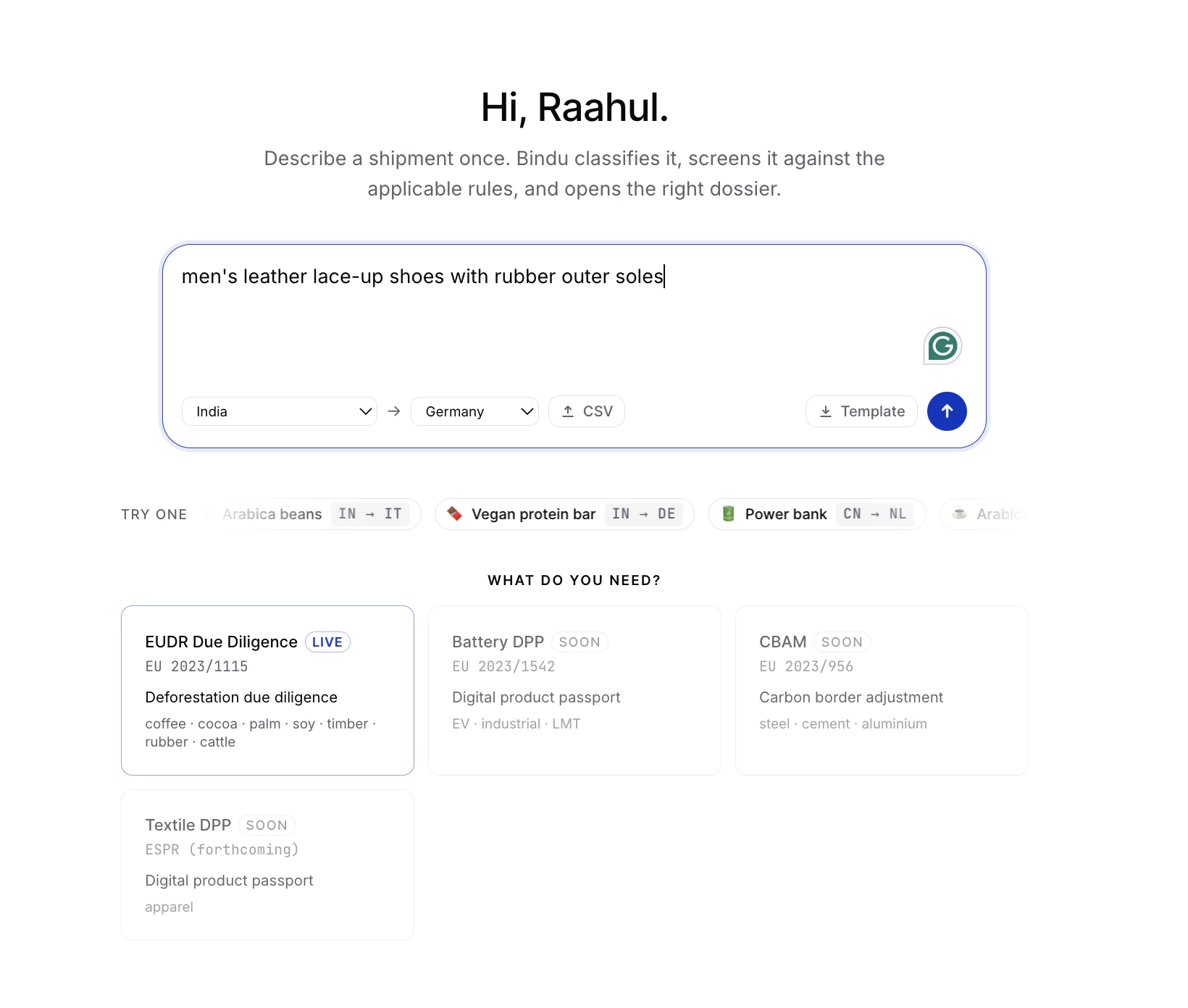
Start with a sentence, not a spreadsheet
Describe a shipment in plain words. Bindu classifies it, screens which regulations apply, and opens the right dossier.
The whole picture
Full Circle.
Three acts, one operating system. Pick an act. Each one plays itself.
SC 01 · INT. AMSTERDAM DESK · MORNING
SC 02 · ROUTE A · THE BEST PRICE
SC 03 · ROUTE B · THE DATASPACE
SC 04 · ROUTE C · THE WALLED GARDEN
SC 05 · ACT I CURTAIN
€2.10/pc
€2.60/pc
€2.35/pc
DIGITAL TWIN · LOT 4417
cotton · Gujarat IN
cert · GOTS 7.0 ✓
dye house · Tiruppur
water · 2,140 L / energy · 96 kWh
DECLINED · NO STORY
SELECTED
DECLINED · CAN'T CONNECT
"Rahul buys the world and sells it to Europe. From here on,
nothing crosses without its story." Same tee. Three quotes. Three very different answers.
"Best price, brother. Ship Friday." · "Where's the cotton from?" · silence.
"He didn't have the answer. He had something better: a wire to whoever did."
By evening the passport was on Rahul's desk. The cotton hadn't left the mill.
"We have all the data." He did. It lived in a beautiful prison.
Price gets you to the table. Proof gets you across the border.
Protocol is how proof travels.
SC 06 · SAME DESK, DIFFERENT CARGO
SC 07 · ORIGIN A · THE WRONG PLOT
SC 08 · ORIGIN B · THE COOPERATIVE
SC 09 · ORIGIN C · SILENCE
LAND REGISTRY
title · none found
class · state forest
SATELLITE
canopy · until 2022
then · bare ground
DUE DILIGENCE STATEMENT
plots · 412 ✓ legality · 412 ✓
ref ·
DECLINED · NOT LEGAL
SELECTED
DECLINED · NO STORY
Textiles ask where a shirt was made. Coffee asks something harder:
show me the exact patch of earth.
"The paperwork said farm. The satellite said forest, until 2022."
"One question went down the mountain.
Four hundred small answers came back up." Filed before the ship left port.
Third origin, third week of waiting. Some silences are answers.
SC 10 · THE SHOPPER
SC 11 · THE RECYCLER
SC 12 · THE BORDER, REVISITED
SC 13 · FULL CIRCLE
Materials
95% organic cotton, 5% elastane. Field: Gujarat. Mill: Tiruppur.
Care & repair
Wash cold. Line dry. Free repair: 3 partner shops nearby.
The story
Field → mill → Route B → your hands. Every hop verified.
SORTER READOUT
fiber · 95% co / 5% ea
coating · none · finish · clean
verdict · SHRED & RESPIN ✓
BATTERY · SAME SCAN
chem · LFP · disassembly map ✓
DUTY 12% ✓
VAT 21% ✓
ESPR · DPP ✓
EUDR · N/A
She didn't ask the customs officer's questions. The passport answered hers anyway:
wash cold, repair here, made from these fields.
Fifteen washes later, the tee comes home. The sorter doesn't guess.
Shred it. Spin it. Start again.
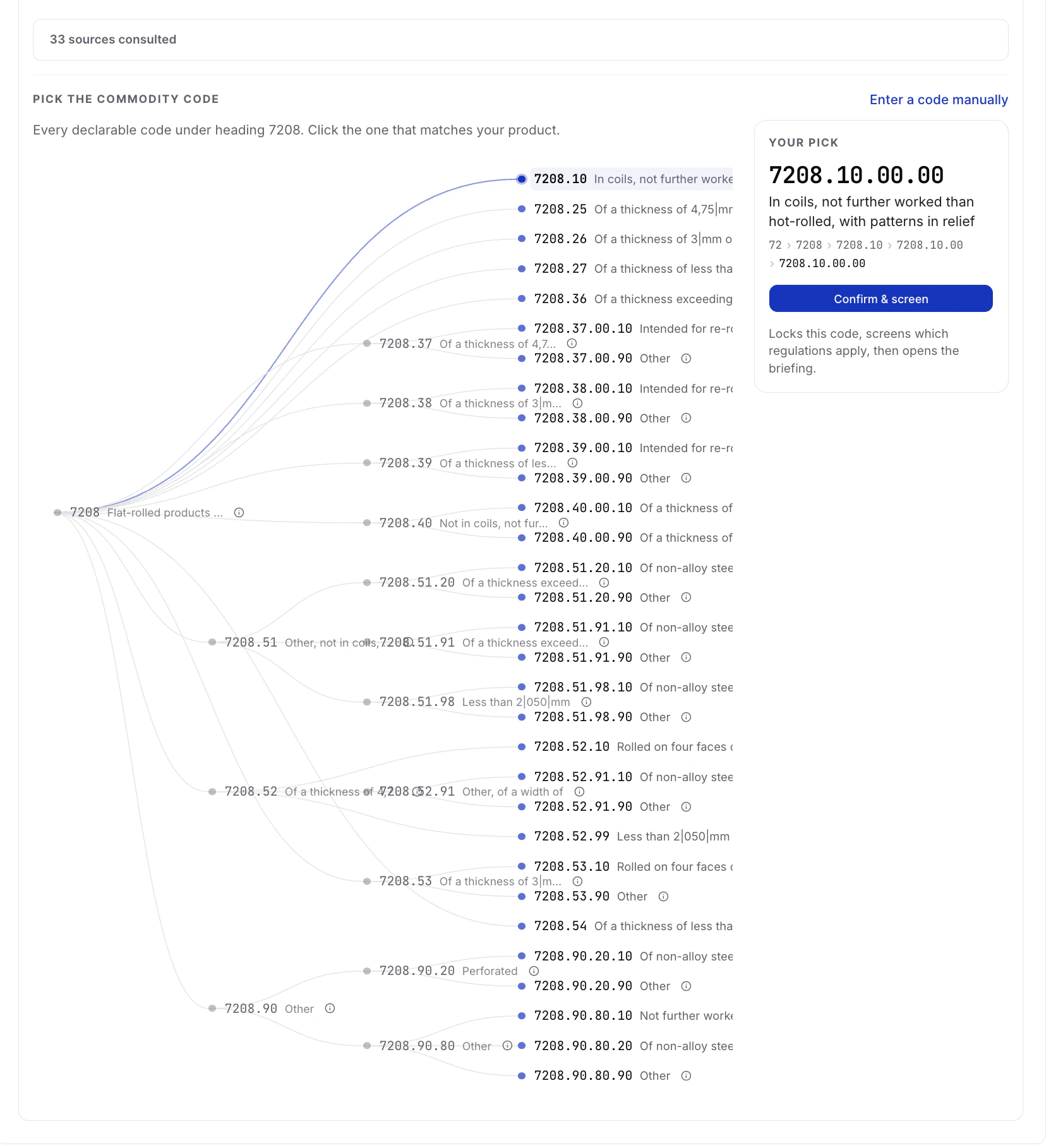
One scan. The code, the duty, the rules, before the container touches the crane.
The thread that started in a field ends in a field of data,
and starts again.
The layer underneath
How the proof will move between companies.
The people who hold the proof are farmers, co-ops, traders and mills, each inside their own company. Bindu (the word means dot) is building the layer that lets them hand proof over without handing over their data. The identity half runs today. The exchange half is next.
When compliance data moves between companies, it travels sealed, readable only by the party it is addressed to. The design is set and the identity it depends on is already minted. The transport itself is not live yet.
Where this is going: your systems and your partners' systems settle routine paperwork between themselves, every step signed and accounted for. Nothing on this row is live yet.
The rails we are building on are Eclipse Tractus-X, the same open-source components the German auto industry runs its supply-chain data on. We are not inventing the plumbing. Today every workspace is single-tenant and your data stays inside it; nothing crosses to another company until this layer ships.
Ask your supply chain
Stop chasing documents. Just ask.
Type a question. Your suppliers' own systems work out the answer, a real person on their side hits approve, and you get it back signed. Nobody emails files around.
Answers are sealed to the asker. Bindu carries the envelope and can't open it. Not won't. Can't.
Before anything leaves, your supplier sees exactly what you'll learn, and can say no. Their files never move.
Every answer is signed by the company that gave it. Paste it in your filing, show it to your auditor.
Where the dots lead
Where all this paperwork is heading.
The EU calls it the circular economy. At the border, it's the law. Your folder is how you get in.
Prove.
Satellite-checked, signed, dated. Evidence a border guard accepts on sight.
Pass.
Every product carries its passport. Scan the label, read its life.
Return.
The passport outlives the sale. The battery comes back, and its chemistry comes back with it. The loop closes. The books balance.
Worked examples
What the rules let through, and what they stop.
Ten of them, written from the regulations themselves. Illustrations, not customer filings: the verdict on a real shipment belongs to the rules and to the authority that reads them.
And you're not doing it alone
Who we're building this with.
We're building Bindu in the open, in conversation with customs brokers and exporters in India, Uganda, Ecuador, Brazil, Mexico, Bangladesh and the Netherlands, with trade ministries and customs authorities, and with the large importers piloting Bindu today. Published pricing, no sales calls, and the demo runs on your own shipments. Bring your next shipment. We'll keep the folder.
Illustrations of how the conversations run.
Plot maps for lot 7 attached. All 41 farms are inside the co-op.
Received. 41 plots verified. Dossier updated.
Segue o CAR da fazenda. Colheita de julho.
Recebido. CAR anexado ao lote 12.
Adjunto el permiso de la finca. ¿Falta algo para el embarque?
Nada más. Expediente completo.
इनवॉइस INV-2214 के साथ प्लॉट का नक्शा भेज दिया है।
Received. Plot 12 verified against INV-2214.
ডাইং ইউনিটের সার্টিফিকেট পাঠিয়ে দিলাম।
Received. Certificate filed to the passport.
Pricing
Book a 30-minute demoWhat each filing costs.
One platform for five regulations. You pay per filing, not per seat.
EUDR · due-diligence dossier
€249a dossier. €199 to file, €50 to keep.
Per filingno seats, no annual licence
- €199 files the DDS to TRACES and returns the reference customs asks for.
- €50 keeps it the five years the law requires.
- €100 keeps it the full ten years.
- €20 a month keeps your workspace live to file.
Industry: The alternatives bill per seat or per year. Bindu bills per dossier filed.
One platform files EUDR, CBAM, battery and textile passports. Keeping your workspace live is €20 a month. EU-hosted, GDPR compliant. Prices exclude VAT.